Star Tracker vs Equatorial Mount: Which One Should You Buy?

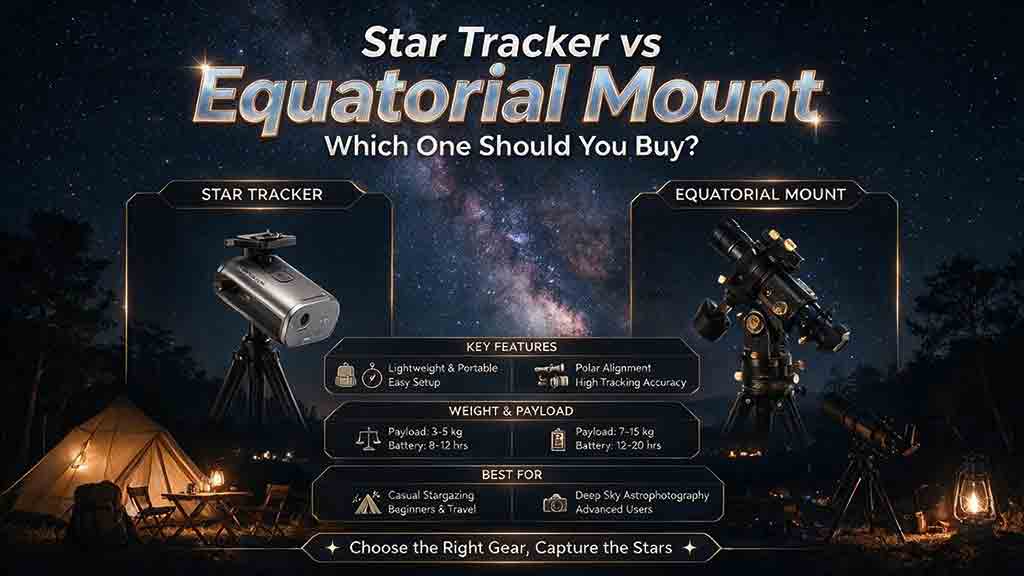
Star Tracker vs Equatorial Mount: Which One Should You Buy?
Buy a star tracker if you mainly use camera lenses, prioritize portability, and can work within modest payload and automation limits. Buy an equatorial mount if you plan to use a telescope, longer focal lengths, dual-axis guiding, GoTo, plate solving, or automated sequences. A dual-axis GoTo tracker sits between the two. Choose by complete payload, torque, focal length, software, transport, and future upgrades—not the product label alone.
Key Takeaways
- A compact star tracker is usually the better purchase for wide-angle and moderate-telephoto camera-lens astrophotography.
- A full equatorial mount is usually better for telescopes, longer focal lengths, heavier accessories, dual-axis guiding, and automation.
- Dual-axis GoTo trackers create a useful middle category, so this is not always a strict two-product choice.
- Payload ratings indicate mechanical compatibility; they do not guarantee round stars at a particular focal length or exposure time.
- The best value comes from the system you will carry, balance, polar align, power, and use consistently.
This guide compares tracking architecture, payload, torque, focal length, guiding, GoTo, plate solving, meridian behavior, portability, power, software, and complete system cost. It also provides two original calculations, a seven-step decision framework, real-world scenarios, troubleshooting, and a buying checklist.
Editorial note: This guide is based on official mount manuals, current manufacturer specifications, astronomy-control standards, and practical selection criteria rather than hands-on testing of a specific tracker, equatorial mount, tripod, telescope, or guiding system.
Which Should You Buy: a Star Tracker or an Equatorial Mount?
Choose a star tracker for portable camera-lens imaging. Choose an equatorial mount when stability, payload, longer focal length, guiding, GoTo, and automation are more important than minimum weight and fast setup.
| Buying situation | Better starting choice | Why |
|---|---|---|
| Milky Way with a 14–35 mm lens | Star tracker or fixed tripod | Low payload and wide field favor portability |
| Constellations with a 50–85 mm lens | Star tracker | Tracking adds useful exposure flexibility without a large mount |
| Nebulae with a 100–200 mm lens | High-capacity tracker or compact equatorial mount | Focal length, balance, and guiding begin to matter more |
| Camera with a small refractor | Compact GoTo tracker or equatorial mount | Telescope accessories increase load and automation needs |
| Long-focal-length telescope | Equatorial mount | Stronger axes, saddle, guiding, and tripod are usually required |
| Automated imaging from a computer | Equatorial mount or capable dual-axis tracker | GoTo, drivers, plate solving, and meridian management matter |
| Hiking or airline travel | Star tracker | Lower transport weight and fewer components |
| Permanent or semi-permanent setup | Equatorial mount | Setup complexity matters less than repeatability |
| Beginner with no clear target | Start simpler | Learn untracked capture or a basic tracker before building a full rig |
| User planning major telescope upgrades | Equatorial mount | Buying enough mount once may reduce repeated replacement |
A star tracker is a lightweight equatorial tracking device usually designed around cameras, lenses, and small optical systems.
An equatorial mount is a motorized astronomical mount whose right-ascension axis is aligned with Earth’s rotation axis. Many full mounts also provide a powered declination axis, GoTo pointing, guiding, computer control, and heavier mechanical support.
Why Is This Not a Perfect Two-Category Comparison?
Modern products form a spectrum rather than two completely separate groups.
Basic single-axis star tracker
A basic tracker generally provides:
- Motorized right-ascension tracking
- Manual target framing
- Camera screw, ball head, or small dovetail
- Limited payload
- Low transport weight
- Minimal software dependence
- Optional or RA-only guiding on some models
The iOptron SkyGuider Pro manual, for example, describes a camera-oriented mount with an RA drive, polar alignment system, counterweight option, and an ST-4 guiding port.iOptron
Dual-axis GoTo tracker
This bridge category may provide:
- Motorized RA and declination axes
- GoTo target finding
- Wi-Fi or USB control
- Dual-axis balancing
- Autoguiding
- A V-style saddle
- Small-telescope capability
- Higher setup complexity than a basic tracker
The Sky-Watcher Star Adventurer GTi manual describes a portable dual-axis GoTo mount with an 11-pound stated payload, Wi-Fi, computer connectivity, and ST-4 autoguiding.Sky-Watcher USA That example shows why the word “tracker” does not always mean single-axis or manually aimed.
Full equatorial mount
A full German equatorial mount or center-balanced equatorial mount commonly provides:
- Larger RA and declination drive assemblies
- Heavier counterweights and tripod
- Telescope-oriented saddle
- Dual-axis guiding
- GoTo and computer control
- Better accommodation of focusers, filters, guiders, and cables
- More room for future payload growth
- Greater transport and power requirements
Current official examples illustrate the category gap: Sky-Watcher lists the HEQ5 at 30 pounds of payload and the HEQ5-R Pro at 33 pounds, both with GoTo and autoguider support.Sky-Watcher USASky-Watcher USA These figures are manufacturer limits, not exposure guarantees or buying recommendations.
How Do Star Trackers and Equatorial Mounts Differ in Practice?
| Feature | Basic star tracker | Dual-axis GoTo tracker | Full equatorial mount |
|---|---|---|---|
| Primary use | Camera and lens | Camera, lens, or small telescope | Telescope imaging and heavier systems |
| Powered axes | Usually RA only | RA and DEC | RA and DEC |
| Target finding | Manual | GoTo | GoTo common |
| Guiding | None or RA only on many models | Model dependent, often dual-axis | Dual-axis common |
| Plate solving | Limited by control system | Often possible with compatible software | Common in automated systems |
| Payload | Modest | Moderate | Moderate to high |
| Tripod demand | Camera or dedicated tripod | Dedicated tripod usually preferred | Substantial tripod or pier |
| Counterweight | Optional or small | Usually included | Standard and heavier |
| Focal-length comfort | Wide to moderate telephoto | Moderate telephoto to small telescope | Small to long telescope focal lengths |
| Meridian behavior | Often manually managed | Software and design dependent | Important for many German equatorial mounts |
| Power | Internal battery or low-power input common | Battery or external DC | External DC commonly required |
| Transport | Easiest | Middle | Heaviest |
| Setup time | Shortest | Moderate | Longest |
| Growth path | Limited | Moderate | Strongest |
| Typical failure point | Alignment, ball head, or overload | Balance, software, or tripod | Power, cables, guiding, balance, or automation |
The table describes common patterns, not universal specifications. Always check the exact manual.
When Is a Star Tracker the Better Purchase?
A star tracker is the better purchase when portability and camera-lens imaging matter more than maximum payload and automation.
You mainly use wide and normal lenses
A tracker is well matched to:
- Milky Way fields
- Constellations
- Tracked panoramas
- Meteor backgrounds
- Wide-field comets
- Large nebulae
- Star fields
- Lightweight travel systems
At wide focal lengths, small polar and tracking errors are less visible than they are through a telescope.
You carry the system far from a vehicle
A compact rig may include:
- Camera
- Lens
- Tracker head
- Equatorial wedge
- Ball head or dovetail
- Small counterweight
- Tripod
- Battery
- Dew heater
A full equatorial mount can require several separate loads: mount head, tripod, counterweights, power system, telescope, camera, and accessory case.
You value fast setup
A basic tracker can reduce the number of decisions involving:
- Home position
- GoTo alignment
- Plate solving
- Driver configuration
- Meridian limits
- Guiding calibration
- Cable routing
- Automated shutdown
Simple equipment is valuable when a short clear period or changing weather limits the session.
You do not need unattended imaging
Manual framing is acceptable for:
- Bright Milky Way regions
- Wide constellations
- Large targets visible in a test exposure
- Short sessions
- Travel photography
A simple tracker becomes less attractive when target acquisition consumes most of the available darkness.
When Is an Equatorial Mount the Better Purchase?
An equatorial mount is the better purchase when the imaging train behaves like a telescope system rather than a camera-and-lens kit.
The complete payload is growing
A telescope rig may add:
- Optical tube
- Camera
- Field flattener or reducer
- Filter drawer or filter wheel
- Electronic focuser
- Off-axis guider or guide scope
- Guide camera
- Dew heaters
- Rotator
- Mini computer
- Power and data cables
The mount must carry and control the complete moving system, not only the telescope or camera.
You use longer focal lengths
Longer focal lengths reveal:
- Polar-alignment error
- Periodic error
- Backlash
- Wind
- Tripod flex
- Cable drag
- Differential flexure
- Focus shift
A stronger mount does not eliminate these effects, but it usually provides a more suitable mechanical and control platform.
You need repeatable target acquisition
GoTo and plate solving become valuable when:
- The target is invisible in one short exposure
- The camera has a small field of view
- The session continues across several nights
- A mosaic must repeat accurately
- The system is controlled remotely
- Filters or focus sequences consume time
You want automation
A full imaging sequence may require:
- Slewing
- Plate solving
- Centering
- Guiding
- Dithering
- Autofocus
- Filter changes
- Meridian management
- Parking
- Weather response
A mount is only automatable when its firmware, driver, controller, and capture software expose the necessary functions.
How Does Focal Length Change the Decision?
Focal length is one of the strongest practical indicators, but it is not a fixed product boundary.
| Actual focal length or system | Likely best category | Main reason |
|---|---|---|
| 14–35 mm camera lens | Tripod or star tracker | Wide field tolerates more tracking error |
| 50–85 mm camera lens | Star tracker | Portable tracking provides a clear benefit |
| 100–200 mm camera lens | Capable tracker or compact EQ mount | Balance and periodic error become more visible |
| 200–300 mm camera lens | High-capacity tracker or EQ mount | Guiding, tripod, and framing requirements increase |
| Small refractor near 250–500 mm | GoTo tracker or EQ mount | Telescope accessories and dual-axis control matter |
| Medium refractor or reflector | Equatorial mount | Payload, torque, guiding, and wind require stronger support |
| Long-focal-length telescope | Substantial equatorial mount | Small errors create large image displacement |
These bands are workflow guidance rather than exposure guarantees. Pixel size, camera resolution, target declination, wind, guiding, tripod stiffness, and the required star shape can move the boundary substantially.
Why Is Payload Rating Not Enough?
Payload is only a mass limit. Tracking performance also depends on torque, balance, focal length, stiffness, and the distance of the load from the mount axes.
Calculate the complete moving payload
Include:
- Camera body
- Lens or telescope
- Lens collar
- Ball head
- Dovetail and clamps
- Corrector
- Filter holder or wheel
- Focuser
- Guide equipment
- Dew heater
- Cables carried by the axes
Do not include a counterweight as imaging payload unless the manufacturer defines its rating that way. Follow the product manual’s stated convention.
Illustrative torque comparison
Torque is approximately:
Torque = mass × gravitational acceleration × distance from the axis
Assume a 1.5 kg lens has its center of mass 0.18 m from an axis:
1.5 × 9.81 × 0.18 ≈ 2.65 N·m
Place the same 1.5 kg mass 0.08 m from the axis:
1.5 × 9.81 × 0.08 ≈ 1.18 N·m
The mass is unchanged, but the first arrangement creates more than twice the torque. This is why a long telephoto lens or offset ball head can be harder to track than a compact load of the same weight.
The calculation is illustrative. Real mount loads also involve dynamic motion, flexure, counterweight position, bearing design, and wind.
Use a lens collar when appropriate
A proper collar can place a heavy lens closer to its center of gravity and reduce stress on the camera mount.
Confirm that:
- The collar is made for the exact lens
- The foot is retained securely
- The dovetail cannot slide out
- The camera can rotate without loosening the lens
- Cables do not pull during tracking
How Should You Compare Tracking Performance?
Compare usable integration and frame consistency rather than the longest successful exposure.
Important measures include:
- Percentage of frames with acceptable stars
- Median star eccentricity
- Guiding RMS when guiding is used
- Polar drift
- Periodic error
- Dither recovery
- Time lost to framing and setup
- Wind sensitivity
- Number of rejected frames
Original usable-integration calculation
Use:
Usable integration = frame count × exposure time × acceptance rate
System A captures:
- 60 frames
- 120 seconds each
- 60% acceptance
60 × 120 × 0.60 = 4,320 seconds = 72 minutes
System B captures:
- 80 frames
- 60 seconds each
- 90% acceptance
80 × 60 × 0.90 = 4,320 seconds = 72 minutes
Both systems produce the same usable integration in this example. Longer sub-exposures are not automatically more productive when tracking consistency is lower.
Periodic error
Periodic error is a repeating variation in tracking speed caused mainly by the drive’s gear cycle.
It can produce:
- Alternating sharp and elongated frames
- Back-and-forth RA movement
- A repeating pattern over time
Some full mounts offer permanent periodic-error correction or support guiding that can reduce the effect. Sky-Watcher lists permanent periodic correction on its HEQ5 product page and PEC training on the EQ6-R Pro.Sky-Watcher USASky-Watcher USA
How Do Guiding Capabilities Differ?
Basic trackers may have no guiding or only RA correction, while full equatorial mounts commonly support motor corrections on both RA and declination.
RA-only guiding
RA-only guiding can help correct:
- Periodic RA tracking variation
- Small changes in tracking speed
It cannot motor-correct declination drift caused by polar misalignment.
Dual-axis guiding
Dual-axis guiding can send corrections to:
- Right ascension
- Declination
It can improve consistency, but it cannot fix:
- Wind
- Loose hardware
- A slipping clutch
- Poor focus
- Lens zoom creep
- Differential flexure
- Severe overload
- Clouds
- Cable snags
The Star Adventurer GTi manual describes autoguiding through ST-4 and USB, while full mounts such as the HEQ5 and HEQ5-R also provide autoguider interfaces.Sky-Watcher USASky-Watcher USASky-Watcher USA
ST-4 and software guiding are not the same workflow
ST-4 sends directional guide pulses through a cable between the guide camera and mount.
Software or pulse guiding may communicate through the mount driver. The available features depend on:
- Mount firmware
- Driver
- Controller
- Guiding application
- Operating system
- Cable path
Confirm the exact model rather than assuming that a guide port exposes every software function.
Do You Need GoTo, Plate Solving, and Computer Control?
You do not need these features for every image, but they become increasingly valuable as the field of view narrows and sessions become automated.
GoTo
GoTo slews the mount toward stored celestial coordinates.
It does not guarantee perfect centering because pointing can be affected by:
- Polar error
- Home-position error
- Mechanical cone error
- Alignment model
- Time and location data
- Backlash
Plate solving
Plate solving analyzes a star image to determine where the camera is pointing.
A plate-solving workflow can:
- Slew near the target.
- Capture a short image.
- Solve the star field.
- Calculate the pointing error.
- Correct the mount.
- Repeat until centered.
Plate solving depends on compatible capture software, drivers, mount control, and a camera image with enough detectable stars.
ASCOM and INDI
ASCOM provides standardized astronomy-device interfaces, including mount control and cross-platform Alpaca resources.ASCOM Initiative
INDI provides a standardized telescope interface for slewing, tracking, and device-specific mount capabilities.INDI Technical Documentation
A compatibility label does not prove that every feature works. Verify:
- Slewing
- Sync
- Parking
- Guiding
- Tracking rates
- Side-of-pier reporting
- Meridian behavior
- Firmware updates
- Connection recovery
What Is a Meridian Flip, and Does It Affect Both Choices?
A meridian flip is a repositioning maneuver used by many German equatorial mounts to keep the telescope and counterweight in a safe mechanical orientation after a target crosses the local meridian.
A full German equatorial mount may need to:
- Stop the exposure sequence
- Move the telescope to the opposite side of the pier
- Recenter the target
- Restart guiding
- Resume capture
ASCOM documents pointing state and side-of-pier behavior because software needs this information to manage automated German-mount sequences.ASCOM Initiative
Not every equatorial design behaves identically:
- A basic tracker may require manual reframing.
- A dual-axis GoTo tracker may support software-managed movement.
- A German equatorial mount commonly requires meridian-limit planning.
- A center-balanced mount may have different mechanical clearance, but still requires documented limit management.
Never assume an automated flip is safe without testing cable clearance, tripod clearance, focuser position, and mount limits.
Which Tracking Rates Matter?
Use sidereal tracking for stars and most deep-sky targets. Other rates are specialized.
Common options include:
- Sidereal: stars and most deep-sky objects
- Lunar: the Moon
- Solar: the Sun, with proper solar safety equipment
- Custom or non-sidereal: selected moving targets when supported
A standard sidereal tracker follows the stars, not a fast-moving comet’s independent motion. Comet work may require:
- Shorter tracked exposures
- Custom-rate tracking
- Separate star-aligned and comet-aligned stacks
- Clear composite disclosure
Never look through a polar scope at the Sun. Solar imaging also requires a verified front-aperture solar filter or a purpose-built solar telescope; tracking rate alone does not make the system safe.
Which Option Is More Portable?
A star tracker is usually more portable, but compare the complete packed system rather than the mount head alone.
Star-tracker transport list
- Tracker head
- Wedge
- Tripod
- Ball head or declination bracket
- Counterweight and shaft
- Camera
- Lens
- Batteries
- Dew heater
- Cables
Equatorial-mount transport list
- Mount head
- Tripod or pier
- Counterweights
- Telescope
- Camera and accessories
- Power supply
- Guide equipment
- Computer or controller
- Cable set
- Cases
Use the “number of carries” test
Before buying, estimate:
- Total packed weight
- Heaviest individual component
- Number of trips from vehicle to site
- Setup time
- Breakdown time
- Storage space
- Whether stairs are involved
- Whether the system can be transported safely alone
A mount that remains unused because transport is difficult offers less value than a smaller system used regularly.
Which Option Is Faster to Set Up?
A basic tracker usually wins for speed; a full mount wins for repeatability after the workflow is configured.
Tracker setup commonly requires
- Stable tripod
- Tracker and wedge
- Counterweight or ball head
- Camera and lens
- Balance
- Polar alignment
- Manual framing
- Test exposure
Equatorial-mount setup commonly requires
- Tripod or pier
- Mount head
- Counterweight shaft and weights
- Telescope and accessories
- RA and DEC balance
- Power and data
- Polar alignment
- Home position
- Driver connection
- GoTo or plate solving
- Guiding
- Cable and meridian test
A permanent or semi-permanent mount can reverse this comparison because the heavy alignment and cable work may remain in place.
How Do Power and Software Requirements Differ?
A tracker usually has the simpler power plan, while a full equatorial system requires a complete power and communications design.
Check:
- Required voltage
- Polarity
- Minimum current
- Connector dimensions
- Battery chemistry
- Cold-weather limits
- Fuse requirements
- Cable strain relief
- Whether power is shared with heaters or computers
- Offline operation
The SkyGuider Pro manual specifies model-specific USB power and temperature guidance, while the Star Adventurer GTi manual specifies its own battery and 12 V requirements.iOptronSky-Watcher USA Do not transfer one mount’s power specification to another.
Before buying a computer-controlled mount, verify:
- Current manufacturer application
- Firmware-update process
- Windows, macOS, or Linux support
- ASCOM or INDI driver
- Mobile-app requirements
- Offline functionality
- USB or serial chipset
- Wi-Fi behavior
- Supported guiding method
- Recovery after connection loss
Software support can change while the mechanical mount remains usable.
How Should You Calculate Total System Cost?
Calculate the complete working system and the likely next upgrade, not only the mount-head price.
Star-tracker cost worksheet
Include:
- Tracker
- Equatorial wedge
- Tripod
- Ball head or declination bracket
- Counterweight kit
- Dovetail
- Polar-alignment accessory
- Power
- Dew control
- Interval control
- Case
Equatorial-mount cost worksheet
Include:
- Mount and tripod or pier
- Counterweights
- Dovetail plates
- Telescope rings
- Power supply
- Computer or controller
- Guide camera and guide scope or OAG
- Cables and powered hub
- Cases
- Additional counterweight
- Software when applicable
Add ownership costs
Also consider:
- Shipping
- Tax or customs
- Replacement cables
- Batteries
- Firmware-support risk
- Repair shipping
- Storage
- Vehicle space
- Setup assistance
Do not use a low mount-head price to justify a system that still lacks the tripod, wedge, saddle, guiding, or power needed for the intended work.
What Seven-Step Decision Framework Should You Use?
Step 1: Define the next twelve months of targets
Choose the dominant use:
- Wide Milky Way
- Constellations
- Telephoto nebulae
- Small refractor
- Medium telescope
- Planetary telescope
- Automated deep sky
Do not buy mainly for a distant hypothetical system unless the upgrade plan is realistic.
Step 2: Record actual focal length
Longer focal length usually favors the stronger mount before raw payload reaches its limit.
Step 3: Calculate the complete moving load
Include all accessories and the expected center of gravity.
Step 4: Define the workflow
Decide whether you need:
- Manual framing
- GoTo
- Plate solving
- Dual-axis guiding
- Dithering
- Meridian management
- Remote operation
Step 5: Test transport
Simulate carrying, assembling, and storing every component.
Step 6: Price the complete system
Include the equipment required to make the mount usable on the first night.
Step 7: Choose the smallest system that meets the real requirement
Do not choose a tracker that will immediately be overloaded. Do not choose a full mount so heavy that it will not be used.
Real-World Buying Scenarios
These scenarios demonstrate the framework rather than report hands-on product tests.
Scenario 1: Wide-Field Traveler
Equipment plan:
- Mirrorless camera
- 20 mm and 35 mm lenses
- Airline travel
- No telescope
Better choice:
Star tracker.
Reason:
The low payload, wide field, and travel requirement do not justify a full equatorial mount.
Scenario 2: Milky Way and 135 mm Nebulae
Equipment plan:
- Camera
- 24 mm lens
- 135 mm lens
- Portable tripod
- Occasional guiding interest
Better choice:
A capable tracker or dual-axis GoTo tracker.
Reason:
The 135 mm lens benefits from more precise tracking, but the system may remain compact enough to avoid a full mount.
Scenario 3: Small Refractor With Future Filter Wheel
Equipment plan:
- 350 mm refractor
- Cooled camera
- Reducer
- Electronic focuser
- Guide system
- Future filter wheel
Better choice:
Equatorial mount.
Reason:
The accessories, dual-axis guiding, cable management, and upgrade plan make a telescope-oriented mount more practical.
Scenario 4: Long-Lens Wildlife Photographer Adding Astrophotography
Equipment plan:
- Heavy 300 mm lens
- Camera
- Lens collar
- No telescope
- Vehicle access
Better choice:
Compare a high-capacity tracker with a compact equatorial mount.
Reason:
The lens may fit within a tracker’s mass rating but create high torque and wind sensitivity. The stronger tripod and axes of a mount may improve consistency.
Scenario 5: Backyard Automated Imaging
Equipment plan:
- Telescope
- Filter wheel
- Electronic focuser
- Mini computer
- Multi-hour sequences
Better choice:
Equatorial mount with verified drivers and automation support.
Reason:
Repeatable pointing, dual-axis guiding, plate solving, meridian management, and parking outweigh portability.
Scenario 6: Beginner Unsure About Deep Sky
Equipment plan:
- Existing camera and 50 mm lens
- Limited budget
- No experience with polar alignment
Better choice:
Begin with untracked stacking or a basic tracker.
Reason:
A full mount adds cost and complexity before the target, workflow, and long-term interest are known.
What Are the Pros and Cons of a Star Tracker?
Star tracker advantages
- Lower transport weight
- Faster setup
- Lower entry cost
- Works well with camera lenses
- Smaller power requirement
- Easier airline and hiking use
- Fewer cables
- Simple manual workflow
- Useful for wide-field tracked panoramas
Star tracker limitations
- Lower payload
- Less mechanical stiffness
- Limited GoTo on basic models
- Limited or RA-only guiding on some models
- Manual framing can be slow
- Ball heads can slip
- Long lenses reveal periodic error and flex
- Upgrade path is limited
- Telescope accessories may overwhelm the system
What Are the Pros and Cons of an Equatorial Mount?
Equatorial mount advantages
- Stronger payload and torque control
- Better telescope support
- Dual-axis guiding
- GoTo and computer control
- Plate-solving workflow
- Better automation potential
- Larger saddles and counterweights
- Stronger tripod or pier
- Better growth path
- Repeatable multi-night framing
Equatorial mount limitations
- Higher total cost
- Heavier transport
- Longer setup
- More power demand
- More cables and software
- Greater learning curve
- Meridian and collision planning
- Larger storage requirement
- More components that can fail
What Common Buying Mistakes Should You Avoid?
| Mistake | Why it causes problems | Better approach |
|---|---|---|
| Buying by payload number alone | Torque and focal length are ignored | Calculate complete load and geometry |
| Assuming every tracker is single-axis | GoTo trackers blur category boundaries | Read the exact manual |
| Assuming every guide port corrects both axes | Some trackers guide RA only | Verify axis support |
| Buying a full mount for one wide lens | Portability and setup may prevent use | Choose the simplest adequate system |
| Placing a telescope near a tracker’s limit | Accessories and wind reduce consistency | Plan the complete future rig |
| Ignoring tripod quality | Mount performance is lost through flex | Evaluate the support system |
| Forgetting counterweight safety | Weight can slide and cause injury or damage | Install the safety stop first |
| Moving clutches without supporting the load | Equipment can swing suddenly | Hold the system during balance |
| Treating GoTo as perfect centering | Pointing models have error | Use plate solving when needed |
| Assuming automation works because ASCOM is listed | Required functions may be missing | Test the exact driver and software |
| Ignoring meridian clearance | Telescope or cable can collide | Test limits before unattended use |
| Using an unverified power supply | Wrong voltage or polarity can damage electronics | Follow the manufacturer specification |
| Comparing mount-head weight only | Tripod, weights, power, and cases dominate transport | Compare the complete packed system |
| Chasing maximum exposure length | Rejected frames reduce usable data | Optimize acceptance rate and integration |
Why Are Stars Elongated on Both Systems?
The likely cause is polar error, periodic error, balance, focus, tripod movement, wind, or cable drag rather than the category name.
Troubleshoot in this order:
- Shorten the exposure.
- Confirm focus.
- Check the tracking rate.
- Improve polar alignment.
- Rebalance both axes or the tracker load.
- Tighten the saddle, head, and tripod.
- Remove cable tension.
- Check wind and ground stability.
- Compare center and corner stars.
- Review several consecutive frames.
| Star pattern | Likely cause |
|---|---|
| Steady drift in one direction | Polar error, wrong rate, or slipping head |
| Back-and-forth RA elongation | Periodic error |
| Random movement | Wind, tripod contact, or cable drag |
| Only corners stretched | Lens or telescope aberration |
| Whole frame soft without direction | Focus, dew, or vibration |
| Sudden large jump | Clutch slip, gear disengagement, or cable pull |
Why Does GoTo Miss the Target?
Possible causes include:
- Incorrect home position
- Wrong time, date, or location
- Poor polar alignment
- Incomplete pointing alignment
- Cone error
- Backlash
- Incorrect driver coordinates
- Loose saddle
- Camera field too narrow
Use plate solving when compatible, but first verify that the mount’s time, location, hemisphere, and home position are correct.
Why Does Guiding Look Worse on the Larger Mount?
Possible causes include:
- Incorrect calibration
- Excessive guide exposure
- Poor polar alignment
- Backlash
- Aggressive settings
- Differential flexure
- Bad seeing
- Loose guide scope
- Cable movement
- Incorrect mount driver mode
A stronger mount cannot compensate for an incorrectly configured guide system.
Why Does the Tracker Work at 35 mm but Fail at 200 mm?
A longer lens makes the same angular tracking error occupy more pixels.
Additional causes include:
- More lens torque
- Narrower field
- Higher wind sensitivity
- Poor lens-collar support
- Smaller pixel pitch
- Inadequate polar alignment
- Ball-head flex
- Periodic error
Reduce exposure length and simplify the load before concluding that the tracker is defective.
Why Does the Mount Stop or Reverse Near the Meridian?
The system may have reached:
- A configured meridian limit
- A safety limit
- A required pier-side change
- A cable or tripod clearance limit
- An automation rule
Do not override the limit until the manual, cable path, telescope clearance, and software behavior are understood.
Star Tracker vs Equatorial Mount Buying Checklist
Define the work
- Main targets selected
- Actual focal lengths recorded
- Telescope upgrade plan documented
- Need for GoTo identified
- Need for guiding identified
- Need for automation identified
- Travel and storage limits recorded
Calculate the load
- Camera weighed
- Lens or telescope weighed
- Corrector and filters included
- Focuser included
- Guide equipment included
- Dovetail and rings included
- Cables and heaters included
- Center of gravity considered
- Lens collar or tube rings confirmed
Check mount functions
- Powered axes confirmed
- GoTo capability confirmed
- Guiding axes confirmed
- ST-4 or pulse-guiding support confirmed
- Tracking rates confirmed
- Parking behavior confirmed
- Meridian behavior confirmed
- Plate-solving workflow confirmed
- Firmware-update path confirmed
Check support and power
- Tripod or pier included
- Counterweights included
- Safety stops included
- Saddle type matches
- Voltage confirmed
- Polarity confirmed
- Current requirement confirmed
- Cold-weather plan prepared
- Cable strain relief planned
Check software
- Manufacturer application available
- Operating system supported
- ASCOM or INDI driver verified
- Exact model appears in supported-device list
- Guiding software connection tested
- Capture software can slew and park
- Meridian behavior tested
- Offline workflow available
Check practical value
- Complete packed weight calculated
- Heaviest component can be carried safely
- Setup time is acceptable
- Storage space is available
- Complete system cost calculated
- First-year targets justify the purchase
- Smaller or larger alternative compared
How We Developed This Comparison
This guide uses seven priorities:
- Target before product category: wide lenses and telescopes need different support.
- Focal length before payload marketing: tracking precision becomes more visible as image scale increases.
- Torque before weight alone: geometry changes the load on the axes.
- Usable integration before record exposure length: repeatable frames create more productive data.
- Workflow before feature count: GoTo and guiding matter only when the capture process uses them.
- Complete transport before mount-head weight: tripods, counterweights, power, and cases determine portability.
- Current compatibility before assumed automation: drivers and firmware must support the required functions.
No tracker, equatorial mount, telescope, camera, lens, tripod, guider, or controller was hands-on tested for this article.
Which One Should You Buy?
Choose a star tracker when camera lenses, travel, fast setup, and low weight define the system. A basic tracker is sufficient for many wide-field projects, while a dual-axis GoTo tracker can extend the workflow to telephoto lenses and selected small telescopes.
Choose an equatorial mount when the system includes a telescope, heavy accessories, long focal length, dual-axis guiding, plate solving, or multi-hour automation. Buy for the complete planned rig rather than the optical tube alone.
For a first purchase, choose the smallest system that meets the next twelve months of real targets. For an upgrade, identify the current failure—payload, focal length, guiding, framing, automation, or transport—and buy only when the new mount solves it.
Frequently Asked Questions
Is a star tracker an equatorial mount?
A star tracker uses an equatorial tracking principle, but the term usually refers to a lightweight camera-oriented device with lower payload and fewer automation features. Some dual-axis GoTo trackers overlap with compact equatorial mounts, so the exact functions matter more than the label.
Can a star tracker carry a small telescope?
Some can, when the complete load, focal length, balance, saddle, tripod, and manufacturer limits are suitable. A telescope plus corrector, focuser, camera, guider, and cables may exceed the tracker’s practical precision before exceeding its stated mass limit.
Is an equatorial mount more accurate than a star tracker?
It is usually designed for greater payload, stiffness, dual-axis control, and automation, but accuracy depends on the exact model, polar alignment, periodic error, balance, guiding, tripod, and focal length. The product category alone does not guarantee a specific tracking result.
Do you need GoTo for astrophotography?
No. Wide and bright targets can be framed manually. GoTo becomes valuable for narrow fields, faint targets, repeatable multi-night framing, plate solving, mosaics, and automated sequences.
Should a beginner buy a star tracker first?
A tracker is often the better first motorized mount for a camera and lens because it teaches polar alignment and tracked capture with less weight and cost. A beginner with a telescope and clear automation goals may be better served by a compact equatorial mount.
Can a full equatorial mount replace a star tracker?
Yes for tracking capability, but not for portability. A full mount may be unnecessarily heavy and slow to deploy for wide-angle travel photography. Owning both can make sense when the use cases are genuinely different.
Sources
Sources were checked August 19, 2026.
- iOptron — SkyGuider Pro Camera Mount Instruction Manual
- Sky-Watcher USA — Star Adventurer GTi User’s Manual
- Sky-Watcher USA — HEQ5 Mount
- Sky-Watcher USA — HEQ5-R Pro
- Sky-Watcher USA — EQ6-R Pro
- ASCOM Initiative — Standards for Astronomy
- INDI Technical Documentation — Telescope Interface
- ASCOM Initiative — Pointing State and Physical Side of Pier for German Mounts
- NASA Night Sky Network — Introduction to Astro Imaging, Part 2
- iOptron — CEM26 Instruction Manual
- iOptron — GEM45 German Equatorial Mount Manual
- Sky-Watcher USA — User Manuals
- ASCOM Initiative — Documentation Center
- INDI Drivers Documentation — Driver Categories
More from Trackers Mounts & Filters
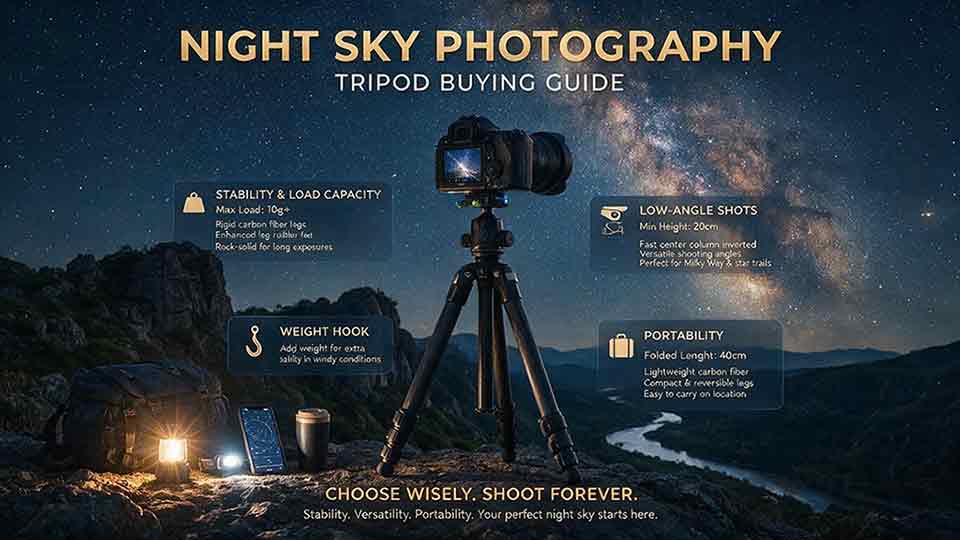
Tripod Buying Guide for Night Sky Photography
A tripod for night sky photography should be selected by stability, complete system load, working height, head security, terrain, wind exposure, and realistic carry weight rather than payload alone. This guide explains the difference between safely holding equipment and remaining steady during long exposures. It compares carbon fiber and aluminum, three-, four-, and five-section legs, center columns, twist and flip locks, ball and geared heads, leveling bases, quick-release systems, feet, and tracker-compatible platforms. Readers receive an illustrative complete-load calculation, a seven-question decision framework, six practical use scenarios, step-by-step setup guidance, troubleshooting, environmental maintenance advice, and a detailed buying checklist. The central recommendation is to choose the lightest tripod that remains dependable with the exact camera, lens, head, tracker, wind, and ground conditions in which it will actually be used.
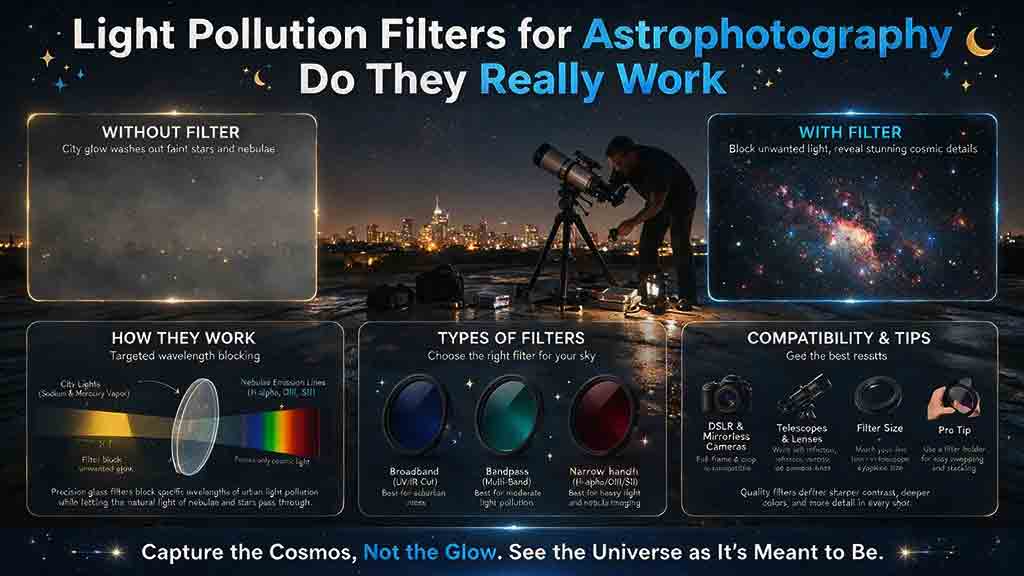
Light Pollution Filters for Astrophotography: Do They Really Work?
Light pollution filters can improve astrophotography, but their value depends on the target spectrum, local lighting, filter transmission curve, camera, and optical system. Dual-band and narrowband filters are most effective on emission nebulae because they isolate hydrogen-alpha, oxygen, and other narrow emission lines while rejecting much of the sky background. Broadband suppression filters offer smaller and less predictable gains on galaxies, reflection nebulae, star clusters, and Milky Way nightscapes, especially under broad-spectrum LED lighting. This guide compares filter categories, explains fast-optics passband shift, vignetting, focus changes, color casts, and halos, and provides an illustrative contrast and signal-to-noise calculation. Readers also receive a seven-question decision framework, matched A/B testing procedure, practical scenarios, troubleshooting, a complete buying checklist, and an essential warning that nighttime astrophotography filters are never safe solar filters.
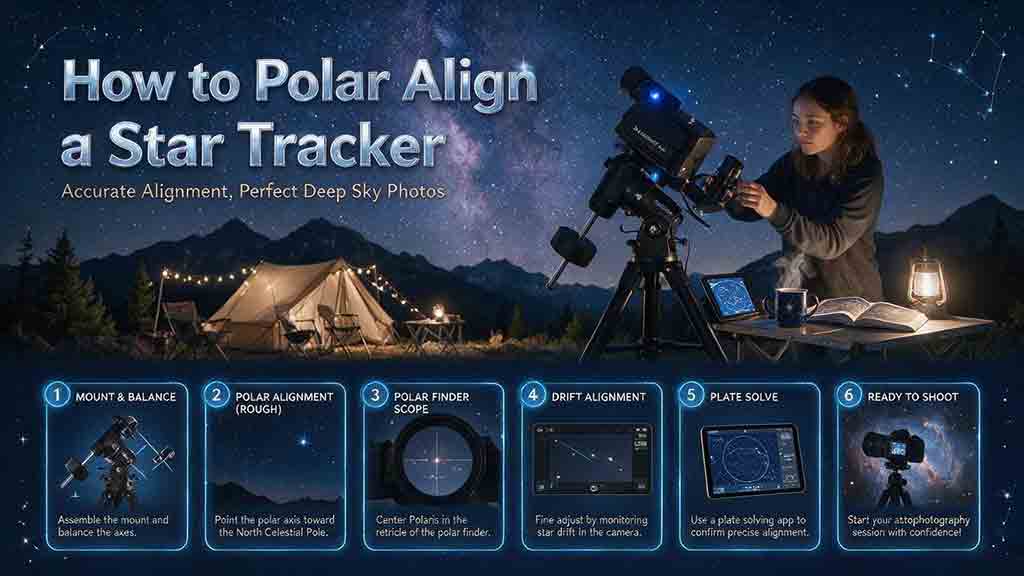
How to Polar Align a Star Tracker
Polar alignment points a star tracker’s right-ascension axis toward the north or south celestial pole so the mount can follow the apparent motion of the sky. This guide explains how to prepare and balance the tracker, identify true north or south, set the wedge near local latitude, and refine alignment with an optical polar scope, model-specific reticle app, electronic polar camera, plate-solving routine, or drift method. Separate Northern and Southern Hemisphere instructions explain why Polaris must be offset from the north celestial pole and how the faint Octans pattern is used in the south. Readers also receive a three-pass workflow, method-selection table, exposure-escalation test, practical scenarios, safety and setup checklists, common mistakes, polar-scope calibration test, and detailed troubleshooting guidance. The article distinguishes polar alignment from GoTo star alignment, balancing, plate solving, and autoguiding.
Explore More Topics
Dedicated Astronomy Camera vs Regular Camera: What Is the Difference?
A dedicated astronomy camera is designed for telescope imaging through astronomy software and may provide regulated cooling, high-frame-rate readout, monochrome capture, filter-wheel integration, and FITS metadata. A regular DSLR or mirrorless camera is a self-contained general-purpose camera with a screen, battery, memory card, native lenses, autofocus, and daytime usefulness. This guide explains why neither category is universally better. It compares cooled deep-sky cameras, uncooled planetary cameras, guide cameras, monochrome and one-shot-color sensors, regular cameras, and specialized astrophotography DSLRs. Readers learn how cooling, dark current, H-alpha response, UV/IR filtering, sensor size, pixel scale, back focus, software, power, calibration, frame rate, and total system cost affect the decision. The article also includes calculation examples, use-case recommendations, a five-question selection process, a buying checklist, common mistakes, troubleshooting, and practical next steps.

How to Choose a Camera for Astrophotography
Choosing an astrophotography camera starts with the target, optical system, and workflow rather than megapixels or sensor size alone. This guide compares mirrorless and DSLR bodies, cooled one-shot-color cameras, cooled monochrome cameras, planetary cameras, and astronomy-modified models. Readers learn how sensor dimensions affect field of view, how pixel size and focal length determine image scale, and how cooling, quantum efficiency, read noise, full-well capacity, dynamic range, and frame rate should be interpreted. It also provides a color-versus-monochrome comparison, telescope compatibility and back-focus checks, software and driver requirements, a total-system-cost framework, five practical scenarios, troubleshooting, and a complete purchase checklist. The central recommendation is to choose the camera that fits the target, corrected image circle, mount, software, power system, processing workflow, and complete budget.
Best Focal Lengths for Milky Way Photography
For most untracked Milky Way landscapes, a 14–24mm full-frame-equivalent view offers the best balance of sky coverage, galactic scale, foreground context, and shutter-time tolerance. Wider 12–16mm views suit dramatic foregrounds and a large Milky Way arch, while 28–35mm makes the galactic center more prominent. Focal lengths of 40–50mm or longer are better for panoramas, stacking, or tracked high-detail images. This guide converts the recommendations for full-frame, 1.5× APS-C, 1.6× Canon APS-C, and Micro Four Thirds cameras. It explains shutter-time tradeoffs, crop-factor calculations, aperture and corner-performance limits, prime-versus-zoom choices, panorama planning, and tracker use. Readers also receive a three-question lens-selection method, real-world scenarios, a step-by-step lens test, a buying checklist, common mistakes, troubleshooting guidance, and practical recommendations without unsupported “best lens” claims.