Light Pollution Filters for Astrophotography: Do They Really Work?

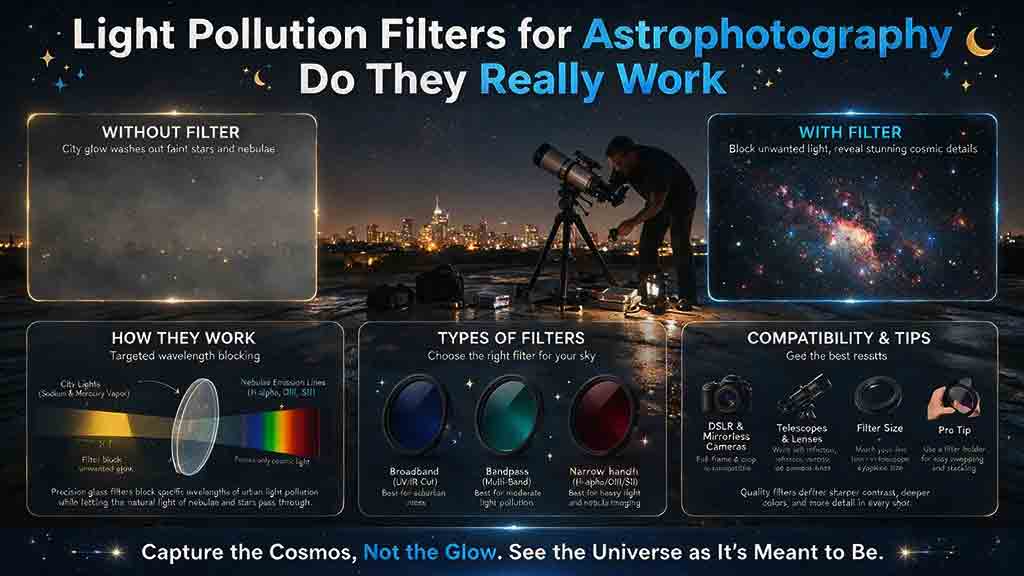
Light Pollution Filters for Astrophotography: Do They Really Work?
Yes, light pollution filters can work, but only when the filter’s transmission bands match the target and the local sky glow. Dual-band and narrowband filters can strongly improve contrast on emission nebulae. Broadband suppression filters provide smaller, less predictable gains on galaxies, reflection nebulae, star clusters, and nightscapes—especially under broad-spectrum LED lighting. No filter can replace darker skies, sufficient integration, accurate calibration, or careful processing.
Key Takeaways
- Light pollution filters improve contrast by rejecting selected wavelengths; they do not make a target intrinsically brighter.
- Emission nebulae usually benefit most because their strongest light is concentrated in narrow spectral lines.
- Galaxies, reflection nebulae, star clusters, and the Milky Way emit broad-spectrum light, so aggressive filtering also removes useful target signal.
- Modern white LEDs spread energy across much of the visible spectrum, making traditional broadband light-pollution rejection less selective.
- Filter bandwidth, optical speed, camera type, filter size, reflections, and calibration can matter as much as the product label.
This guide explains which filters work for which targets, why LEDs changed the result, how broadband, dual-band, and narrowband filters differ, how to estimate contrast and signal-to-noise improvement, and how to test a filter fairly before deciding whether it belongs in your imaging system.
Editorial note: This guide is based on published specifications, authoritative light-pollution resources, optical-filter documentation, and practical selection criteria rather than hands-on testing of a specific filter, camera, lens, telescope, or sky location.
Do Light Pollution Filters Really Work?
They work when they reject a large fraction of unwanted sky glow while transmitting a large fraction of the target’s useful light. They work poorly when the target and the light pollution occupy the same wavelengths.
| Target | Filter approach most likely to help | Expected result | Main limitation |
|---|---|---|---|
| Hydrogen-rich emission nebula | Dual-band filter with a color camera, or H-alpha/O III/S II filters with monochrome | Stronger target-to-background contrast | Star color, halos, optical-speed shift, and long exposure requirements |
| Planetary nebula | O III, dual-band, or suitable narrowband | Often strong contrast improvement | Target spectrum varies; very narrow filters may reduce stars heavily |
| Supernova remnant | Narrowband or dual-band | Can isolate emission structures | Some remnants contain mixed or broad-spectrum components |
| Galaxy | Mild broadband filter, or no filter | Sometimes darker background | Target light is broad spectrum, so target signal is also removed |
| Reflection nebula | Mild broadband filter, or dark sky | Limited and site-dependent benefit | Reflected starlight is broad spectrum |
| Open or globular cluster | Mild broadband filter, or no filter | Small possible background improvement | Stars are broad-spectrum sources |
| Milky Way nightscape | Mild lens-compatible broadband filter | May reduce some urban glow | Color cast, foreground filtering, LED overlap, and lens reflections |
| Moon or planets | Usually no light-pollution filter | Little benefit from sky-glow rejection | Exposure is short and targets are bright |
| Comet | Target-dependent | Some gas emissions may benefit | Dust continuum and moving-target workflow complicate the choice |
The U.S. National Park Service explains that artificial light scattered through the atmosphere raises sky brightness and reduces contrast between astronomical objects and the background.U.S. National Park Service A filter can reduce part of that background, but it cannot recover photons from the target that were never recorded.
What Is a Light Pollution Filter?
A light pollution filter is an optical filter designed to transmit selected astronomical wavelengths while attenuating some wavelengths associated with artificial sky glow.
Important terms:
- Transmission curve: a graph showing how much light the filter passes at each wavelength.
- Passband: the wavelength range intentionally transmitted.
- FWHM: full width at half maximum, a common way to describe the effective width of a narrow transmission band.
- Out-of-band blocking: the filter’s ability to reject wavelengths outside its intended passbands.
- Skyglow: increased night-sky brightness caused by artificial light scattered in the atmosphere.
- Emission line: light concentrated near a specific wavelength, such as hydrogen-alpha or doubly ionized oxygen.
- Continuum source: an object that emits or reflects light across a broad range of wavelengths.
A product name such as “light pollution,” “city,” “UHC,” “CLS,” “dual-band,” or “nebula” is not enough to predict performance. The transmission curve is more informative than the marketing category.
Why Did Modern LED Lighting Change Filter Performance?
Traditional light-pollution filters were easier to design around lighting sources with strong, narrow spectral emissions. Broad-spectrum white LEDs overlap more of the same visible wavelengths used by stars, galaxies, and reflection nebulae.
Older discharge lighting created stronger spectral targets
Low-pressure sodium, high-pressure sodium, and mercury-vapor lighting often produced identifiable peaks or groups of wavelengths. A filter could reject some of those regions while preserving useful astronomical bands.
White LEDs spread light more broadly
Many white LEDs combine a blue-emitting diode with phosphors that produce a broader visible spectrum. DarkSky International and the National Park Service both note the strong blue content and skyglow consequences associated with modern outdoor lighting.DarkSky InternationalU.S. National Park Service
The practical result is:
- Blocking a narrow sodium line may no longer remove most local sky glow.
- A broad rejection region can also remove starlight and galaxy light.
- Filter effectiveness can differ between neighborhoods using different lamps.
- A filter designed around legacy lighting may behave differently after an LED conversion.
- Atmospheric moisture, aerosols, snow, and nearby illumination change the observed sky spectrum.
A peer-reviewed model of phosphor-converted LED lighting at Haleakalā Observatory showed that the spectral design of outdoor lighting materially affects night-sky brightness across different bands.Source 4
Does that mean filters no longer work?
No. Narrowband and dual-band filters still work well when the astronomical target emits in narrow lines that can be isolated from most of the background.
The largest uncertainty is usually with broadband targets, where modern LED skyglow and target signal overlap strongly.
Which Types of Filters Are Used for Astrophotography?
Broadband and Multi-Band Light Pollution Filters
Broadband suppression filters transmit much of the visible spectrum while reducing selected artificial-light regions. They aim to preserve more natural star color than narrowband filters.
Typical uses:
- Galaxies
- Reflection nebulae
- Star clusters
- Milky Way fields
- Nightscapes
- General deep-sky color imaging
Potential benefits:
- Darker raw background
- Reduced orange or yellow cast from some lighting
- Improved gradient control in favorable conditions
- More natural stars than aggressive narrowband filtering
- Compatibility with color cameras
Limitations:
- Modest benefit under broad-spectrum LEDs
- Target signal is also attenuated
- White balance and color calibration become more difficult
- Exposure time may need to increase
- Local sky spectrum determines the result
- Gradients from nearby lights can remain
- Not a substitute for dark-sky travel
Optolong’s official L-Pro documentation explicitly states that a light-pollution filter does not eliminate light pollution or make the object brighter.Optolong That limitation applies broadly, regardless of brand.
Dual-Band Filters for One-Shot-Color Cameras
A dual-band filter passes two narrow spectral regions—commonly hydrogen-alpha and O III—so a color camera can record major emission-nebula signals while rejecting much of the remaining visible spectrum.
Typical uses:
- Hydrogen emission nebulae
- Planetary nebulae
- Supernova remnants
- Emission-rich wide fields
- Imaging during moderate moonlight, subject to target separation and conditions
Potential benefits:
- Strong contrast under urban or suburban skies
- Simultaneous red and blue-green emission capture
- Efficient workflow for one-shot-color cameras
- Less background than a broadband filter
- Useful with DSLR, mirrorless, and color astronomy cameras when mechanically compatible
Limitations:
- Poor match for galaxies and reflection nebulae
- Star colors become restricted
- O III halos may occur around bright stars
- Color channels do not receive equal target signal
- Narrow bands require longer total integration
- Fast optics may shift the passband
- Some targets emit weakly in one transmitted band
Official dual-band product documentation from Optolong and Antlia illustrates filters centered near hydrogen-alpha and O III for emission-nebula imaging.OptolongAntlia Product claims should still be verified against independent raw data and the exact optical system.
Single Narrowband Filters for Monochrome Cameras
Single narrowband filters isolate one emission line at a time, giving a monochrome camera maximum control over hydrogen-alpha, O III, S II, or other selected signals.
Advantages:
- Strong background rejection
- Independent exposure time for each line
- Flexible false-color or natural-color combinations
- Efficient use of every pixel behind the selected filter
- Better control of weak channels
Limitations:
- Requires a filter wheel or manual changes
- Requires multiple filters for a color image
- More capture and processing time
- Filter focus offsets may need automation
- Large sensors require larger filters
- Narrow bands can be sensitive to optical speed and angle of incidence
- Bright-star halos may differ between filters
A monochrome narrowband system is not merely a stronger broadband-filter system. It is a different acquisition workflow.
UV/IR-Cut Filters
A UV/IR-cut filter blocks ultraviolet and infrared wavelengths that may cause bloated stars or color errors in cameras without sufficient internal blocking. It is not primarily a light-pollution filter.
A UV/IR-cut filter may be needed with:
- Full-spectrum modified cameras
- Some astronomy cameras
- Optical systems that do not focus infrared and visible light together
- Broadband color imaging
Do not assume that every broadband or dual-band filter includes ultraviolet and infrared blocking. Read the complete transmission range.
Visual Nebula Filters
A visual UHC, O III, or H-beta filter is designed around the sensitivity of the human eye and visual observation. It may not be optimized for a camera sensor, infrared blocking, fast optics, or photographic color balance.
Before using a visual filter for imaging, confirm:
- Full spectral transmission
- UV and IR behavior
- Clear aperture
- Coating quality
- Camera compatibility
- Whether the filter is intended for visual, photographic, or both uses
Which Targets Benefit Most?
Emission Nebulae
Emission nebulae are the strongest use case because much of their useful light is concentrated near specific emission lines.
A dual-band or narrowband filter can reject large parts of the sky background while retaining hydrogen-alpha and O III signal.
Good candidates often include:
- Large hydrogen regions
- Planetary nebulae
- Supernova remnants
- Emission-rich complexes
Not every emission target has the same line ratio. An object dominated by hydrogen-alpha may require far more O III integration, while an oxygen-rich planetary nebula may behave differently.
Galaxies
Galaxies are broadband targets, so aggressive filtering removes galaxy signal along with skyglow.
A mild broadband filter can help under some sodium- or mercury-dominated skies, but the result under white LEDs may be small.
For galaxy imaging, improvements often come more reliably from:
- Longer total integration
- Accurate gradient removal
- Better flats
- Moon avoidance
- Higher target altitude
- Darker sites
- Local light shielding
- Correct background calibration
A filter cannot selectively identify “galaxy photons” when they share wavelengths with artificial light.
Reflection Nebulae
Reflection nebulae reflect broad-spectrum starlight, so they generally respond poorly to narrowband filters.
A strong dual-band filter may remove most of the blue continuum that makes a reflection nebula visible.
Use:
- No filter
- A mild broadband filter after testing
- Darker skies
- Accurate color calibration
- Long total integration
Star Clusters
Star clusters contain broad-spectrum stars, making aggressive light-pollution filtering a poor default choice.
A filter may darken the background, but it also reduces and alters starlight. Compare equal total integration and equal output size before deciding whether the filtered result is actually better.
Milky Way Nightscapes
A mild broadband filter can help some suburban Milky Way scenes, but results are highly dependent on the local lighting spectrum and lens system.
Potential problems include:
- Strong magenta, cyan, or green color cast
- Uneven color across a wide-angle frame
- Filter reflections around city lights
- Vignetting from a front-mounted or clip-in filter
- Foreground colors that no longer look natural
- Reduced transmission requiring longer exposure
- Different focus position
- Internal ghosting
A filter placed over a wide lens receives light at a range of incidence angles. Interference filters can shift their spectral response toward the edges, especially with fast or ultra-wide optics.
The Moon and Planets
Light pollution filters are usually unnecessary because the Moon and planets are bright enough for short exposures.
Better priorities include:
- Accurate focus
- Atmospheric seeing
- Collimation
- Appropriate image scale
- Short exposures
- High-frame-rate video
- Correct color balance
Special planetary contrast filters are a separate category and should not be confused with light-pollution suppression.
Comets
A comet can contain both gas emission and broad-spectrum dust reflection, so one filter does not fit every comet.
A narrowband filter may emphasize a gas component while suppressing the dust tail and stars.
A standard light-pollution filter may:
- Change the apparent gas-to-dust balance
- Distort color
- Require longer exposure
- Complicate comet-aligned stacking
Choose based on the comet’s spectrum and the intended scientific or aesthetic result.
Broadband vs Dual-Band vs Narrowband: Which Is Better?
| Decision factor | Broadband suppression | Dual-band | Single narrowband |
|---|---|---|---|
| Best target | Broadband and mixed targets | Emission nebulae with color camera | Emission nebulae with monochrome camera |
| Camera type | DSLR, mirrorless, color astronomy camera | One-shot color; sometimes monochrome | Monochrome preferred |
| Background rejection | Mild to moderate | Strong | Strongest and most selective |
| Natural star color | Best of the three | Restricted | Must be reconstructed from multiple channels |
| Galaxy performance | Sometimes useful, highly site dependent | Poor default choice | Poor for normal broadband color |
| Emission-nebula contrast | Moderate | Strong | Strong and controllable |
| Exposure demand | Moderate | Higher | Higher, especially for weak lines |
| Processing complexity | Moderate | Moderate to high | Highest |
| Fast-optics sensitivity | Lower, but still possible | Important | Important |
| Filter wheel needed | No | No | Usually |
| Color calibration | Required | Specialized | Channel combination required |
| Main purchase risk | Small gain under LEDs | Wrong target or halo behavior | Cost and workflow complexity |
How Much Contrast Can a Filter Add?
A filter can improve target-to-background contrast without increasing the target’s intrinsic brightness. The improvement depends on how much target and background light the filter transmits.
Illustrative contrast and signal-to-noise example
Assume one unfiltered sub-exposure records:
- Target signal: 100 electrons
- Sky background: 900 electrons
- Read noise and dark current ignored for simplicity
Unfiltered target-to-background ratio:
100 ÷ 900 ≈ 0.111
Now assume an illustrative filter transmits:
- 80% of the target signal
- 25% of the sky background
Filtered values:
- Target: 80 electrons
- Background: 225 electrons
Filtered target-to-background ratio:
80 ÷ 225 ≈ 0.356
The target-to-background ratio improves by:
0.356 ÷ 0.111 ≈ 3.2×
That does not mean the final image is 3.2 times better.
Using a simplified shot-noise estimate:
Unfiltered:
100 ÷ √(100 + 900) ≈ 3.16
Filtered:
80 ÷ √(80 + 225) ≈ 4.58
The simplified per-frame signal-to-noise ratio improves by about:
4.58 ÷ 3.16 ≈ 1.45×
This is an illustrative calculation, not a filter performance claim. Real images also include read noise, dark current, airglow, gradients, target structure, sensor response, filter leakage, calibration, and stacking.
What the example teaches
A filter can:
- Remove more background than target signal
- Improve contrast
- Improve signal-to-noise under suitable conditions
- Still require longer exposure because less total light reaches the sensor
A darker-looking raw frame is not proof of better data. Measure target signal, background variation, star quality, and equal-integration results.
Does a Narrower Filter Always Work Better?
No. A narrower band can reject more background, but it also increases sensitivity to wavelength accuracy, optical speed, temperature, angle of incidence, halos, and weak target lines.
A narrower filter may offer:
- Stronger background rejection
- Better moonlight resistance
- Cleaner line separation
- Smaller stars
It may also create:
- Lower total throughput
- Longer required integration
- Greater fast-optics band shift
- More demanding focus
- Stronger channel imbalance
- More noticeable halos
- Higher cost
Choose bandwidth for:
- Target line
- Optical focal ratio
- Camera type
- Sky brightness
- Moon conditions
- Required star appearance
- Total available integration time
Do not rank filters by the smallest FWHM number alone.
Why Do Fast Telescopes Need Special Attention?
Interference filters shift their effective passband when light arrives at steeper angles. Fast optical systems send a wider cone of angles through the filter, which can move an emission line toward the edge or outside the intended passband.
Potential symptoms:
- Weak hydrogen-alpha or O III signal
- Uneven field transmission
- Unexpected color balance
- Stronger loss near frame edges
- One channel requiring much more integration
- Different results after changing focal reducers
Baader’s official high-speed filter documentation explains that selected filters are pre-shifted for specific fast focal-ratio ranges because ordinary narrowband passbands can move away from the target emission line in fast systems.Baader Planetarium
What should you check?
- Manufacturer focal-ratio range
- Transmission curve at multiple incidence angles
- Filter placement in the converging light cone
- Telescope or lens focal ratio
- Reducer or HyperStar configuration
- Sensor size
- Edge performance
- Raw channel strength
“CMOS optimized” does not automatically mean “compatible with every fast optical system.” Check the specified focal-ratio range.
How Does Filter Size Affect Vignetting?
A filter can block part of the converging light cone even when its nominal diameter appears larger than the sensor.
Filter-size requirements depend on:
- Sensor width and diagonal
- Filter clear aperture
- Distance from filter to sensor
- Focal ratio
- Adapter opening
- Filter-wheel opening
- Tilt
- Threaded cell thickness
A filter farther from the sensor intercepts a wider light cone and may need a larger clear aperture.
Warning signs
- Hard dark corners
- A circular cutoff
- One side darker than the other
- Vignetting that flats cannot fully correct
- More severe falloff after adding a reducer
- Clip-in frame shadowing
- Lens contact or mirror-clearance risk
Flat frames can correct gradual illumination falloff, but they cannot restore target detail blocked by a hard mechanical aperture.
Do Filters Change Focus?
Yes. Adding glass changes the optical path, and different filters may shift the best-focus position.
The effect is more noticeable with:
- Fast optics
- Narrowband filters
- Large sensors
- Automated filter changes
- Temperature changes
- High-resolution systems
For a filter wheel:
- Focus with each filter.
- Record repeatable focus offsets.
- Recheck after temperature changes.
- Verify star shape in the center and corners.
- Do not assume filters of equal advertised thickness are perfectly parfocal.
Why Do Filters Create Halos Around Bright Stars?
Halos can result from reflections between the filter, sensor cover glass, corrector, reducer, or other optical surfaces.
Halo appearance can depend on:
- Filter coatings
- Bright-star wavelength
- Sensor cover glass
- Optical spacing
- Filter orientation
- Focal ratio
- Dew
- Dust
- Internal reflections
- Processing stretch
Chroma’s astronomy documentation describes hard optical coatings and anti-reflection treatment as part of filter construction, illustrating why coating design matters.Chroma Technology
Troubleshooting order
- Confirm the halo appears only with the filter.
- Compare several bright stars and positions in the frame.
- Check for dew or contamination.
- Verify manufacturer orientation instructions.
- Change filter spacing only when mechanically safe.
- Test another optical configuration.
- Avoid processing that exaggerates weak reflections.
- Preserve raw evidence before removing halos in software.
A “halo-free” marketing claim should not be treated as universal across every camera and telescope.
How Should You Test a Filter Fairly?
Use matched total integration, similar sky conditions, separate calibration frames, and the same final output.
Step 1: Choose a suitable target
Test:
- An emission nebula for a dual-band filter
- A galaxy or reflection nebula for a broadband filter
- A field with bright stars to inspect halos
- A field near the same altitude in both sequences
Step 2: Record the conditions
Document:
- Date and time
- Moon phase and separation
- Target altitude
- Transparency
- Humidity
- Local lighting
- Camera
- Lens or telescope
- Focal ratio
- Filter
- Exposure
- Gain or ISO
- Temperature
- Total integration
Step 3: Capture matched data
A useful comparison keeps:
- Similar total integration
- Similar target altitude
- Similar moon conditions
- Similar sensor temperature
- Same optical train where possible
- Same focus quality
- Same dithering or tracking workflow
The filtered sub-exposure may need a different duration. Compare equal total integration and preserved highlights, not merely identical shutter settings.
Step 4: Calibrate separately
Capture appropriate:
- Flats with the filter installed
- Dark frames when required by the camera workflow
- Bias or flat-dark frames when required
- Separate flats for each filter orientation or dust configuration
Step 5: Process consistently
Compare:
- Linear background level
- Background standard deviation
- Target signal
- Star color
- Halo intensity
- Gradient complexity
- Equal-output detail
- Total rejected frames
- Processing time
Step 6: Decide by target class
A filter may be valuable for emission nebulae and poor for galaxies. Do not expect one test to settle every use case.
What Is the Best Decision Framework?
Use this original seven-question framework.
1. Is the target an emission-line or continuum object?
Emission target:
- Dual-band or narrowband may be valuable.
Continuum target:
- Use no filter or test a mild broadband filter.
2. What is the local lighting spectrum?
Ask:
- Is the area dominated by legacy sodium lighting?
- Has the city converted to white LED?
- Are nearby sports lights or signs creating gradients?
- Does humidity amplify skyglow?
Without a spectrum meter, use matched test frames and local lighting information rather than assumptions.
3. Which camera is being used?
- One-shot color favors dual-band convenience.
- Monochrome supports separate narrowband filters.
- Modified cameras need verified UV/IR control.
- Unmodified cameras may have reduced hydrogen-alpha sensitivity.
- Clip-in compatibility varies by camera and lens.
4. How fast is the optical system?
Fast optics require documented filter compatibility and may need pre-shifted passbands.
5. Will the filter fit the complete optical train?
Check:
- Sensor size
- Clear aperture
- Filter distance
- Wheel or drawer
- Lens rear clearance
- Camera mirror clearance
- Threads
- Orientation
- Back focus
6. Can the workflow support longer integration and calibration?
Filtering often means:
- Longer exposure
- More total integration
- New flats
- Focus offsets
- More processing
- Different color calibration
7. Is a darker site a better investment?
Compare the filter cost with:
- Dark-sky travel
- Additional integration
- Better local shielding
- Improved flats
- Dew control
- More reliable tracking
- Gradient-processing tools
A filter is useful when it solves a spectral problem, not merely because the sky looks bright.
Practical Recommendation Matrix
| User situation | Practical recommendation |
|---|---|
| Color camera imaging an emission nebula from a city | Test a compatible dual-band filter |
| Monochrome camera imaging emission nebulae | Use matched narrowband filters |
| Galaxy imaging under white LEDs | Prioritize integration, gradients, and darker skies; test only a mild broadband filter |
| Reflection nebula imaging | Prefer no filter or a mild broadband test |
| Wide Milky Way nightscape | Test a lens-compatible broadband filter before buying multiple sizes |
| Fast f/2–f/3 telescope | Use a filter specified for the optical speed |
| Full-frame sensor with filter wheel | Calculate clear aperture and vignetting |
| Bright stars in the field | Research halo behavior and test raw files |
| Unmodified DSLR with weak H-alpha response | Do not expect a dual-band filter to replace sensor response |
| Moon or planetary imaging | Skip light-pollution suppression in most cases |
| Scientific photometry | Avoid uncalibrated light-pollution filters unless the method explicitly accounts for them |
| User who can travel easily to dark skies | Compare travel value before purchasing an expensive filter set |
Real-World Selection Scenarios
These scenarios demonstrate decision logic and are not hands-on product tests.
Scenario 1: Emission Nebula From an LED-Lit Suburb
System:
- One-shot-color astronomy camera
- f/5 refractor
- Hydrogen-rich nebula
- Strong urban skyglow
Practical choice:
A dual-band hydrogen-alpha and O III filter is a reasonable first test.
Why:
The target’s line emissions can be separated from much of the broad sky background.
Scenario 2: Galaxy From the Same Backyard
System:
- Same camera and telescope
- Broadband spiral galaxy
- White LED street lighting
Practical choice:
Begin unfiltered or test a mild broadband filter with equal total integration.
Why:
Aggressive filtering removes galaxy continuum and may only make the raw background look darker.
Scenario 3: Milky Way With an Ultra-Wide Lens
System:
- Mirrorless camera
- Fast 14 mm lens
- Suburban foreground
Practical choice:
Test a mild front-mounted or compatible clip-in filter for color cast, edge response, reflections, and vignetting before committing.
Why:
Wide incidence angles and foreground color can make a filter less predictable than in a telescope.
Scenario 4: f/2 Imaging System
System:
- Fast astrograph
- Color camera
- Dual-band filter designed for slower systems
Practical choice:
Do not assume compatibility. Compare the filter’s specified focal-ratio range and transmission behavior.
Why:
Passband shift can reduce the intended emission-line transmission.
Scenario 5: Monochrome Narrowband System
System:
- Monochrome camera
- Filter wheel
- H-alpha, O III, and S II imaging
- Automated focus
Practical choice:
Use matched filters, verify focus offsets, and plan different integration times by channel.
Why:
The workflow provides maximum control but requires more equipment and processing.
What Are the Pros and Cons?
Advantages
- Higher contrast on suitable targets
- Strong urban emission-nebula capability
- Lower background in selected wavelengths
- Better use of moonlit nights for some narrowband targets
- More flexibility with one-shot-color cameras
- Access to line-specific structures
- Potential reduction in difficult color gradients
- Portable option compared with changing location
Limitations
- Cannot replace dark skies
- Removes target light as well as pollution
- Limited value for broadband objects
- Modern LEDs reduce broadband selectivity
- Color casts require correction
- Longer integration may be necessary
- Halos and reflections can occur
- Fast optics may shift passbands
- Filter size can cause vignetting
- Focus changes and new flats are required
- Marketing names do not define transmission
- Large, premium filters can be expensive
What Common Mistakes Should You Avoid?
| Mistake | Why it causes problems | Better approach |
|---|---|---|
| Buying one filter for every target | Target spectra differ | Match filter to target class |
| Judging by a darker raw frame | Both target and background may be reduced | Compare target SNR at equal integration |
| Assuming all city lights are sodium | Modern LEDs are broad spectrum | Evaluate local conditions |
| Using dual-band on galaxies by default | Galaxy continuum is rejected | Use no filter or test mild broadband |
| Choosing the narrowest FWHM | Fast-optics shift and weak channels are ignored | Match bandwidth to system |
| Ignoring focal ratio | Emission lines may leave the passband | Check high-speed compatibility |
| Ignoring filter size | Hard vignetting can result | Calculate clear aperture |
| Reusing old flats | Dust and illumination change | Capture flats with each filter setup |
| Assuming filters are parfocal | Focus shifts can soften stars | Measure focus offsets |
| Treating “halo-free” as universal | Reflections depend on the full optical train | Test bright stars |
| Ignoring UV/IR behavior | Stars may bloat or colors may shift | Review the full transmission curve |
| Comparing different moon or altitude conditions | The test becomes invalid | Match capture conditions |
| Using an imaging H-alpha filter for solar viewing | It does not provide safe solar attenuation | Use a certified solar system only |
Why Is the Filtered Image Still Bright?
Possible causes:
- Broad-spectrum LED skyglow
- Moonlight inside the passband
- Airglow
- Thin cloud or humidity
- Nearby direct light
- Filter is broadband
- Out-of-band leakage
- Incorrect filter orientation
- Heavy post-processing stretch
- Target is low in the sky
A bright background does not automatically mean the filter is defective.
Why Is the Emission Nebula Weak?
Possible causes:
- Unmodified camera with limited hydrogen-alpha response
- Fast-optics passband shift
- Wrong target type
- Filter centered incorrectly
- Short integration
- Weak O III or H-alpha line in that object
- Heavy haze
- Poor focus
- Dew
- Incorrect debayering
- Target too low
Inspect raw channel data before increasing saturation.
Why Are the Colors Unnatural?
Possible causes:
- Selective passbands
- Unequal hydrogen-alpha and O III strength
- White-balance metadata
- Incorrect debayer pattern
- Strong background neutralization
- Saturated stars
- Broadband filter color bias
- Mixed filtered and unfiltered data
Color calibration can improve consistency, but a dual-band image is not a normal broadband color measurement.
Why Are Bright Stars Surrounded by Halos?
Possible causes:
- Filter reflection
- Sensor cover-glass reflection
- Corrector or reducer reflection
- Dew
- Contamination
- Strong O III response
- Optical spacing
- Processing stretch
- Filter coating behavior
Compare filtered and unfiltered raw frames before attempting software removal.
Why Are the Corners Dark?
Possible causes:
- Filter too small
- Filter too far from sensor
- Fast focal ratio
- Narrow adapter
- Clip-in frame shadow
- Lens hood
- Filter holder
- Tilt
Capture proper flats and inspect whether the cutoff is gradual or hard.
Light Pollution Filter Buying Checklist
Define the target
- Emission or continuum target identified
- Dominant emission lines researched
- Galaxy, reflection nebula, or cluster limitation understood
- Moon and planetary use excluded unless justified
Check the local sky
- Main lighting type investigated
- LED conversion considered
- Nearby direct lights identified
- Moon separation planned
- Humidity and haze considered
- Darker-site alternative compared
Check the camera
- Color or monochrome workflow confirmed
- Internal UV/IR blocking understood
- Modification status documented
- Bayer pattern confirmed
- Clip-in compatibility verified
- Mirror or shutter clearance verified
Check the optics
- Focal ratio recorded
- Fast-optics compatibility confirmed
- Sensor diagonal recorded
- Filter clear aperture recorded
- Filter-to-sensor distance estimated
- Adapter and drawer openings checked
- Back-focus effect considered
- Focus offsets planned
Check the filter specification
- Full transmission curve reviewed
- Passband centers identified
- FWHM identified
- Out-of-band blocking range reviewed
- UV/IR behavior reviewed
- Focal-ratio range reviewed
- Coating and halo documentation reviewed
- Mounted clear aperture confirmed
- Orientation instructions checked
Check the workflow
- Longer sub-exposures are possible
- Total integration plan prepared
- New flats will be captured
- Focus will be repeated
- Color-calibration plan prepared
- Raw test files will be preserved
- Equal-integration comparison planned
- Composite disclosure planned when applicable
Solar Safety Warning
A light-pollution, nebula, O III, UHC, H-alpha imaging, dual-band, or narrowband astrophotography filter is not a safe solar filter.
Never look at or photograph the Sun through an ordinary astronomy imaging filter. Safe solar work requires a certified front-aperture solar filter, a purpose-built solar telescope, or another complete solar system designed for the exact optical configuration.
A nighttime hydrogen-alpha imaging filter is not equivalent to a solar hydrogen-alpha telescope. Incorrect solar filtration can cause permanent eye injury, sensor damage, and internal equipment overheating.
How We Developed This Evaluation Framework
This guide uses seven priorities:
- Target spectrum before filter label: emission and continuum targets respond differently.
- Local sky spectrum before marketing claims: white LEDs change broadband rejection.
- Target signal before dark-looking backgrounds: contrast and SNR matter more than raw brightness.
- Optical speed before bandwidth alone: fast systems can shift interference passbands.
- Complete optical train before nominal diameter: clear aperture and filter distance determine vignetting.
- Matched testing before opinion: equal integration and calibration produce a fair comparison.
- Safety before experimentation: nighttime imaging filters are never substitutes for certified solar filtration.
No filter, camera, lens, telescope, filter wheel, or sky location was hands-on tested for this article.
Should You Buy a Light Pollution Filter?
Buy a dual-band or narrowband filter when emission nebulae are a major target and the filter matches the camera, focal ratio, sensor size, and processing workflow.
Test a mild broadband filter before buying when the main targets are galaxies, reflection nebulae, star clusters, or the Milky Way. Under broad-spectrum LEDs, the improvement may be modest and color correction may offset part of the convenience.
Skip the filter when the main targets are the Moon or planets, when the optical system cannot support the required filter size, or when darker skies and longer integration would solve the problem more effectively.
The most reliable question is not whether light pollution filters work in general. It is whether a specific transmission curve rejects more of the local background than of the chosen target—without creating unacceptable color, halo, focus, or vignetting problems.
Frequently Asked Questions
Do light pollution filters work under LED streetlights?
They can, but broadband filters are generally less selective when white LEDs emit across much of the visible spectrum. Dual-band and narrowband filters remain effective on emission nebulae because they isolate narrow astronomical lines. Results depend on the exact LED spectrum, target, filter curve, and sky conditions.
Which filter is best for galaxies?
There is no universally best galaxy filter. Galaxies emit broad-spectrum light, so aggressive filtering removes galaxy signal. Start unfiltered or test a mild broadband filter with equal total integration. Darker skies, good flats, moon avoidance, and gradient removal often provide greater benefit.
Is a dual-band filter useful with an unmodified DSLR?
It can improve emission-nebula contrast, but an unmodified camera may transmit less hydrogen-alpha than a modified or dedicated astronomy camera. The filter cannot restore spectral response that the camera’s internal filter blocks.
Can a light pollution filter reduce exposure time?
Not necessarily. A filter can improve contrast and signal-to-noise by rejecting more background than target signal, but it also reduces total transmitted light. Longer sub-exposures or more total integration may be required.
Do narrowband filters work with fast f/2 telescopes?
Only when the filter is designed or documented for the fast light cone. Interference passbands can shift at steep incidence angles, reducing transmission of the intended emission line. Verify the manufacturer’s focal-ratio range.
Can an H-alpha astrophotography filter be used to photograph the Sun?
No. A nighttime H-alpha imaging filter does not provide complete solar protection. Use a certified solar filter or purpose-built solar telescope designed for the exact optical system.
Sources
Sources were checked August 19, 2026.
- U.S. National Park Service — Light Pollution
- DarkSky International — Solutions to Light Pollution
- U.S. National Park Service — Light Pollution Sources
- Monthly Notices of the Royal Astronomical Society — Modelling the Effects of Phosphor-Converted LED Lighting on the Night Sky of Haleakalā Observatory
- Optolong — L-Pro Broadband Light Pollution Filter
- Optolong — L-eXtreme Dual-Band Filter
- Antlia — ALP-T Dual-Band 3 nm H-alpha and O III Filter
- Baader Planetarium — Preshift and Fast-Optics Information for CMOS Filters
- Chroma Technology — Astronomy and Astrophotography Filters
- International Astronomical Union — Light Pollution
- U.S. National Park Service — How Light Works
- Monthly Notices of the Royal Astronomical Society — Emission Spectra of Light-Pollution Sources
- European Southern Observatory — Natural Sky Brightness
- Chroma Technology — Filter Orientation Guide
More from Trackers Mounts & Filters
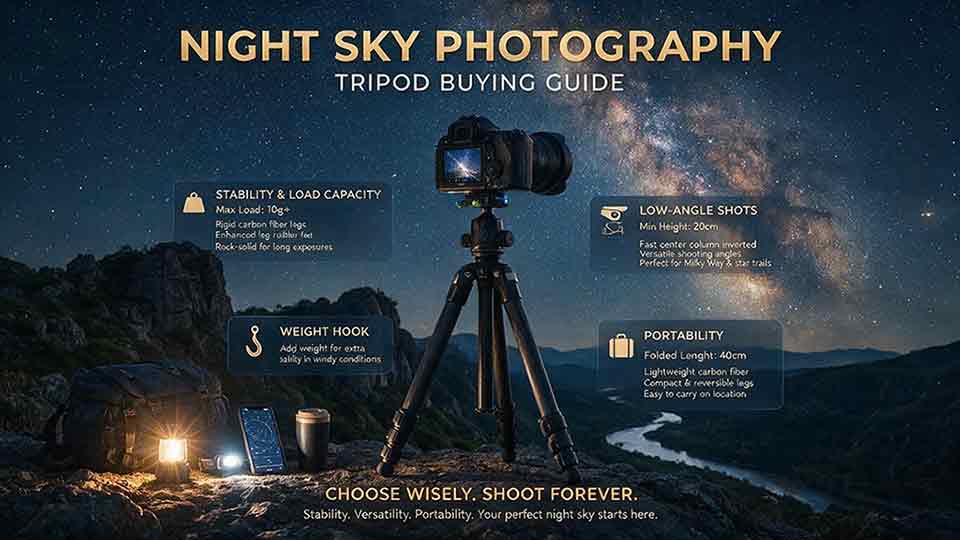
Tripod Buying Guide for Night Sky Photography
A tripod for night sky photography should be selected by stability, complete system load, working height, head security, terrain, wind exposure, and realistic carry weight rather than payload alone. This guide explains the difference between safely holding equipment and remaining steady during long exposures. It compares carbon fiber and aluminum, three-, four-, and five-section legs, center columns, twist and flip locks, ball and geared heads, leveling bases, quick-release systems, feet, and tracker-compatible platforms. Readers receive an illustrative complete-load calculation, a seven-question decision framework, six practical use scenarios, step-by-step setup guidance, troubleshooting, environmental maintenance advice, and a detailed buying checklist. The central recommendation is to choose the lightest tripod that remains dependable with the exact camera, lens, head, tracker, wind, and ground conditions in which it will actually be used.
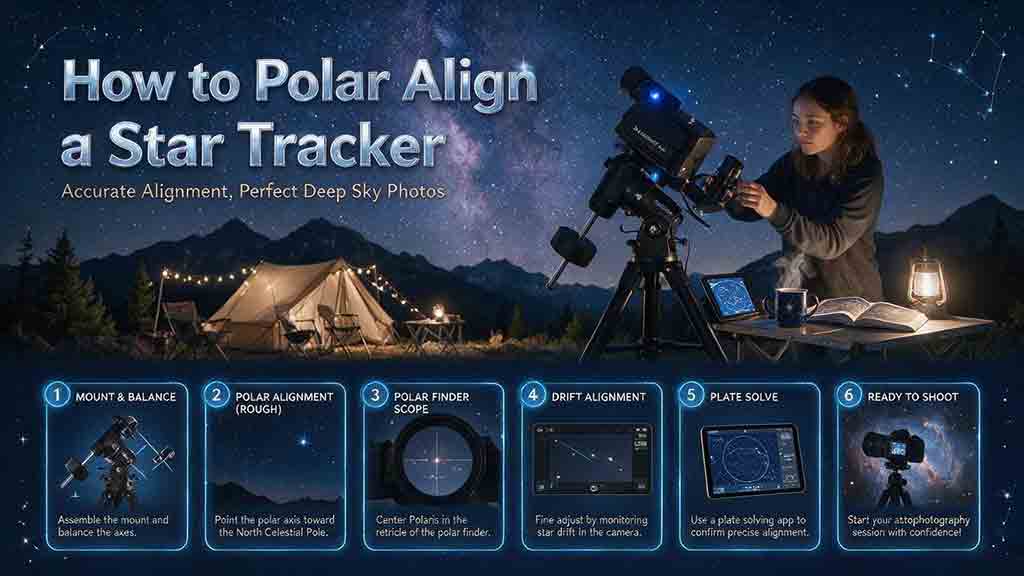
How to Polar Align a Star Tracker
Polar alignment points a star tracker’s right-ascension axis toward the north or south celestial pole so the mount can follow the apparent motion of the sky. This guide explains how to prepare and balance the tracker, identify true north or south, set the wedge near local latitude, and refine alignment with an optical polar scope, model-specific reticle app, electronic polar camera, plate-solving routine, or drift method. Separate Northern and Southern Hemisphere instructions explain why Polaris must be offset from the north celestial pole and how the faint Octans pattern is used in the south. Readers also receive a three-pass workflow, method-selection table, exposure-escalation test, practical scenarios, safety and setup checklists, common mistakes, polar-scope calibration test, and detailed troubleshooting guidance. The article distinguishes polar alignment from GoTo star alignment, balancing, plate solving, and autoguiding.
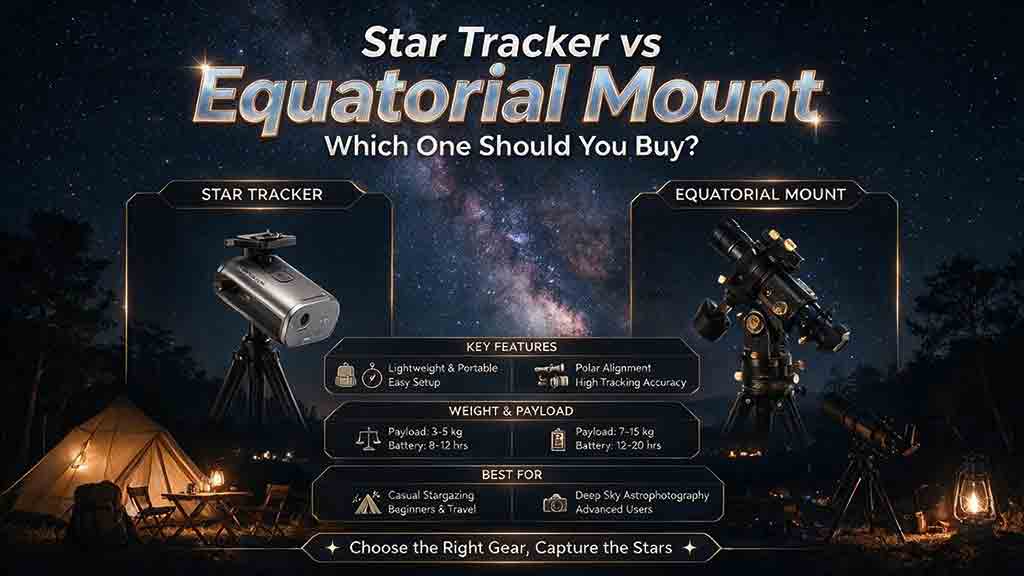
Star Tracker vs Equatorial Mount: Which One Should You Buy?
A star tracker is usually the better purchase for portable camera-lens astrophotography, while a full equatorial mount is better suited to telescopes, longer focal lengths, heavier accessories, dual-axis guiding, GoTo, plate solving, and automated imaging. This guide explains why the market also contains a middle category of dual-axis GoTo trackers, so product labels alone cannot determine the correct choice. It compares payload, torque, tracking consistency, guiding axes, periodic error, meridian behavior, transport, setup time, power, software, and complete ownership cost. Readers receive an illustrative torque calculation, a usable-integration calculation, a seven-step decision framework, six practical scenarios, troubleshooting tables, and a comprehensive buying checklist. The central recommendation is to choose the smallest system that reliably supports the real focal length, complete load, workflow, and upgrade plan.
Explore More Topics
Dedicated Astronomy Camera vs Regular Camera: What Is the Difference?
A dedicated astronomy camera is designed for telescope imaging through astronomy software and may provide regulated cooling, high-frame-rate readout, monochrome capture, filter-wheel integration, and FITS metadata. A regular DSLR or mirrorless camera is a self-contained general-purpose camera with a screen, battery, memory card, native lenses, autofocus, and daytime usefulness. This guide explains why neither category is universally better. It compares cooled deep-sky cameras, uncooled planetary cameras, guide cameras, monochrome and one-shot-color sensors, regular cameras, and specialized astrophotography DSLRs. Readers learn how cooling, dark current, H-alpha response, UV/IR filtering, sensor size, pixel scale, back focus, software, power, calibration, frame rate, and total system cost affect the decision. The article also includes calculation examples, use-case recommendations, a five-question selection process, a buying checklist, common mistakes, troubleshooting, and practical next steps.
How to Choose a Camera for Astrophotography
Choosing an astrophotography camera starts with the target, optical system, and workflow rather than megapixels or sensor size alone. This guide compares mirrorless and DSLR bodies, cooled one-shot-color cameras, cooled monochrome cameras, planetary cameras, and astronomy-modified models. Readers learn how sensor dimensions affect field of view, how pixel size and focal length determine image scale, and how cooling, quantum efficiency, read noise, full-well capacity, dynamic range, and frame rate should be interpreted. It also provides a color-versus-monochrome comparison, telescope compatibility and back-focus checks, software and driver requirements, a total-system-cost framework, five practical scenarios, troubleshooting, and a complete purchase checklist. The central recommendation is to choose the camera that fits the target, corrected image circle, mount, software, power system, processing workflow, and complete budget.
Best Focal Lengths for Milky Way Photography
For most untracked Milky Way landscapes, a 14–24mm full-frame-equivalent view offers the best balance of sky coverage, galactic scale, foreground context, and shutter-time tolerance. Wider 12–16mm views suit dramatic foregrounds and a large Milky Way arch, while 28–35mm makes the galactic center more prominent. Focal lengths of 40–50mm or longer are better for panoramas, stacking, or tracked high-detail images. This guide converts the recommendations for full-frame, 1.5× APS-C, 1.6× Canon APS-C, and Micro Four Thirds cameras. It explains shutter-time tradeoffs, crop-factor calculations, aperture and corner-performance limits, prime-versus-zoom choices, panorama planning, and tracker use. Readers also receive a three-question lens-selection method, real-world scenarios, a step-by-step lens test, a buying checklist, common mistakes, troubleshooting guidance, and practical recommendations without unsupported “best lens” claims.