Shooting & Editing
Explore 5 fascinating articles about shooting & editing
Master the art of night sky photography. Step-by-step guides on exposure settings, focus techniques, and post-processing.
All Articles (5)
How to Edit Milky Way Photos Without Making Them Look Artificial
Edit a Milky Way photo by protecting believable color, smooth tonal transitions, natural star sizes, and a realistic relationship between the sky and foreground. Start with lens corrections and white balance, build contrast gradually, use Dehaze and saturation sparingly, and make local adjustments with soft masks. Judge the result at both full-image view and 100% magnification before exporting.
RAW vs JPEG for Astrophotography
For most astrophotography, shoot RAW. A RAW file preserves substantially more sensor data and gives you greater control over white balance, shadow recovery, color gradients, noise reduction, and stacking. JPEG is useful when speed, storage, or immediate sharing matters, but its in-camera processing and lossy compression leave less room for correcting faint stars and dark skies.
How to Stack Astrophotography Images
To stack astrophotography images, capture a consistent series of RAW exposures, remove technically poor frames, calibrate them when appropriate, align the stars, normalize brightness, reject outliers, and combine the accepted frames with an averaging method. The stack can reduce random noise and reveal faint detail, but it cannot repair missed focus, severe trailing, clipped highlights, or inconsistent capture settings.
How Long Can You Expose Before Stars Begin to Trail?
The longest exposure that keeps stars looking round depends on focal length, sensor resolution, aperture, sky position, and the intended output size. This practical guide explains why the familiar 500 Rule often overestimates safe shutter speeds on modern cameras and shows how the NPF Rule provides a more useful starting point. Readers will learn how to calculate pixel pitch, compare both methods through worked examples, choose realistic starting times for full-frame, APS-C, and Micro Four Thirds cameras, and verify results with a simple field test. The article also distinguishes genuine star trailing from poor focus, lens coma, tripod movement, and atmospheric problems. It concludes with a decision framework for different output needs, a troubleshooting table, a fixed-tripod checklist, and guidance on when stacking or a star tracker is the better solution
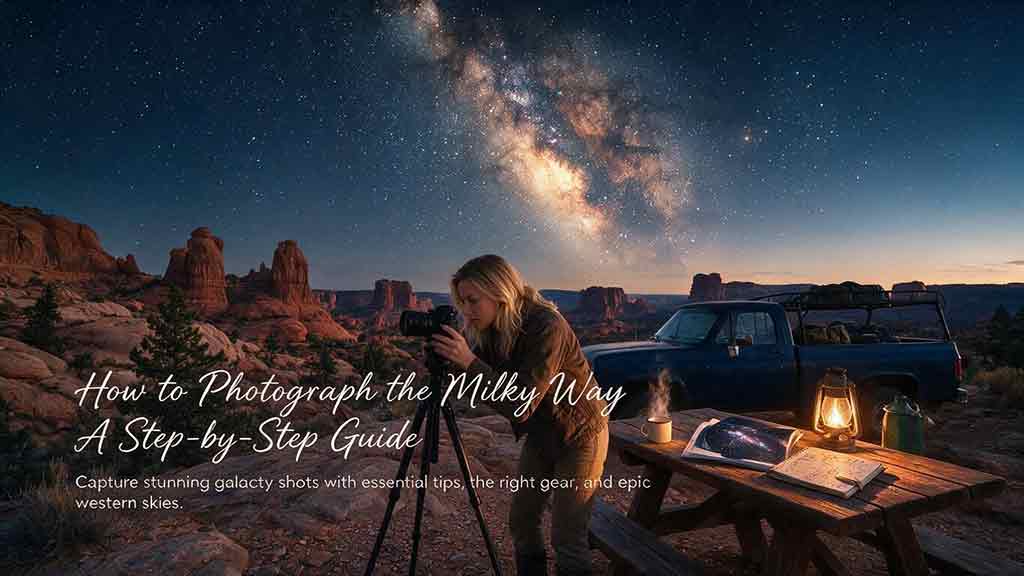
How to Photograph the Milky Way: A Step-by-Step Guide
Photographing the Milky Way becomes manageable when the shoot is planned around dark skies, moon timing, clear weather, and a stable camera setup. This guide walks beginners through the complete process, from choosing a location and lens to focusing on stars, calculating a conservative shutter speed, evaluating test exposures, and capturing frames for stacking. It explains why common starting settings such as a wide aperture, a 10–20 second exposure, and ISO 1600–6400 must be adjusted for focal length, sensor, light pollution, and output size. Readers also get a comparison of single exposures, stacked sequences, star tracking, and blue-hour foreground blends, plus a real-world settings example, editing workflow, field checklist, troubleshooting table, and practical fixes for star trails, soft focus, noise, dew, bright skies, and dark foregrounds. The recommendations are grounded in NASA, National Park Service, camera-manufacturer, and Adobe guidance