Full-Frame vs APS-C Cameras for Night Sky Photography

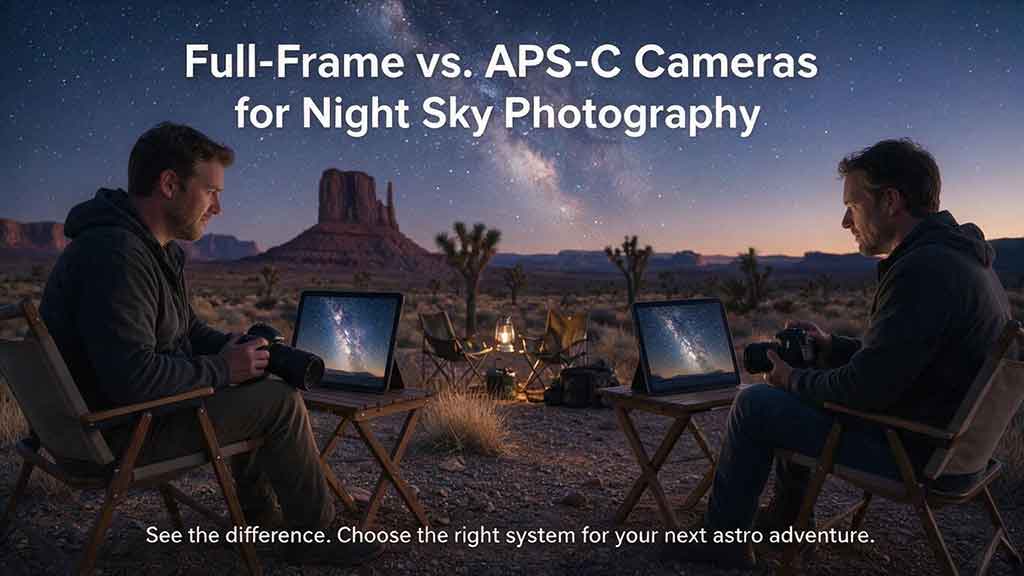
Full-Frame vs APS-C Cameras for Night Sky Photography
For night-sky photography, full frame is usually better when the priority is the widest field, maximum total light collection, and strong high-ISO output from a comparable sensor generation. APS-C is often the better system when cost, portability, higher pixel density, smaller lenses, or easier telescope coverage matter more. The correct choice depends on framing, lens quality, tracking, pixel size, and the complete imaging system—not crop factor alone.
Key Takeaways
- Full frame records a wider field than APS-C with the same lens and camera position.
- APS-C does not magnify the sky; it records a smaller central portion of the lens or telescope image.
- At comparable technology and final output, full frame can offer a total-light and noise advantage, but sensor generation, pixel design, exposure, and processing can reverse a simple body-size ranking.
- APS-C places lower demands on telescope image circles, filters, corner correction, storage, and budget.
- Compare both formats under two separate conditions: the same lens and position, and the same final framing.
This guide explains field of view, crop factor, noise, pixel density, lens requirements, untracked exposure, trackers, telescopes, panoramas, total system cost, and practical buying decisions. It also includes original calculations, real-world scenarios, troubleshooting, and a complete checklist.
Editorial note: This guide is based on published specifications, authoritative documentation, optical calculations, and practical selection criteria rather than hands-on testing of a specific full-frame or APS-C camera.
Which Is Better for Night Sky Photography: Full Frame or APS-C?
Full frame is the stronger general choice for wide nightscapes and maximum image quality when budget, lens quality, and system size permit. APS-C is often the more efficient choice for travel, entry-level budgets, small trackers, telescope imaging, and targets that benefit from a narrower field.
| Decision area | Full frame | APS-C | Practical conclusion |
|---|---|---|---|
| Field of view with the same lens | Wider | Narrower | Full frame for broad Milky Way scenes |
| Total sensor area | Larger | Smaller | Full frame can collect more total light under controlled comparisons |
| Lens corner demands | Higher | Uses a smaller central image area | APS-C is often more forgiving |
| Camera and lens cost | Often higher | Often lower | APS-C can fund a better lens or tracker |
| Body and lens size | Often larger | Often smaller | APS-C can suit hiking and travel |
| Telescope image-circle demand | Higher | Lower | APS-C is easier for many refractors and correctors |
| Filter and accessory size | May require larger components | Often supports smaller components | APS-C can lower total system cost |
| Pixel density | Model dependent | Often high, but not guaranteed | Compare exact pixel size and resolution |
| Small-target framing | More surrounding sky | Target fills more of the frame | APS-C may reduce later cropping |
| Wide-angle lens requirement | Easier to obtain a broad field | Requires a shorter lens for the same field | Full frame is usually simpler for very wide compositions |
| Storage and processing | Often larger files | Often smaller, but resolution matters | Check exact camera specifications |
Canon and Nikon both describe full-frame sensors as recording a wider field than APS-C or DX sensors with the same focal length, while APS-C records a narrower central portion of the projected image.Canon EuropeNikon USA
What Do Full Frame and APS-C Mean?
Full-frame sensor
A full-frame still-camera sensor is approximately the size of a 35 mm film frame, commonly near 36 × 24 mm. Exact dimensions vary slightly by camera.
Full-frame sensors are available in DSLR and mirrorless bodies. “Full frame” describes sensor format, not whether the camera has a mirror.
APS-C sensor
APS-C is a smaller sensor format whose exact dimensions and crop factor vary by manufacturer.
Common crop factors are approximately:
- 1.5× for many Nikon, Sony, Fujifilm, and other APS-C systems
- 1.6× for many Canon APS-C systems
The crop factor compares the field of view with a full-frame camera. It does not change the physical focal length of the lens.
Canon states that its APS-C cameras provide about a 1.6× field-of-view crop, while Nikon identifies DX as its APS-C-class format and FX as full frame.Nikon USACanon Europe
What Is the Most Important Rule for Comparing Sensor Formats?
Always state whether the comparison uses the same lens and position or the same final framing. These are different experiments and produce different conclusions.
Comparison A: Same lens, same position
If both cameras use the same 20 mm lens from the same location:
- Full frame records a wider field.
- APS-C records the central portion.
- The lens aperture and physical focal length remain unchanged.
- The target appears larger relative to the APS-C frame because less surrounding sky is recorded.
- Star movement on the sensor still depends on actual focal length, pixel size, exposure, and target position.
This comparison isolates the field-of-view effect of sensor size more clearly.
Comparison B: Same final framing
To match the full-frame field of a 20 mm lens, an APS-C camera needs a shorter focal length—approximately 13 mm on a 1.5× system or 12.5 mm on a 1.6× system.
Now the comparison also changes:
- Lens design
- Actual focal length
- Aperture diameter
- Corner performance
- Filter compatibility
- Weight
- Price
- Untracked star movement
- Available lens choices
Many online statements become misleading because they switch between these two comparison methods without saying so.
How Does Sensor Size Change Field of View?
At the same focal length, the larger full-frame sensor records a wider angle of the lens or telescope image.
A useful exact formula for one sensor dimension is:
Field of view = 2 × arctan(sensor dimension ÷ (2 × focal length))
Illustrative 20 mm lens calculation
Use representative widths:
- Full frame: 36 mm
- APS-C: 23.5 mm
- Focal length: 20 mm
Full-frame horizontal field:
2 × arctan(36 ÷ 40) ≈ 84.0°
APS-C horizontal field:
2 × arctan(23.5 ÷ 40) ≈ 60.9°
This is an illustrative geometric calculation, not a comparison of two specific camera models. Actual sensor dimensions and recorded image areas vary.
What does that mean in practice?
Full frame makes it easier to include:
- A long Milky Way arch
- Large foreground features
- Multiple constellations
- Aurora extending across the sky
- Broad meteor-shower coverage
- Large nebulae through short telescopes
APS-C gives a narrower composition that can be useful for:
- A Milky Way core region
- Constellation details
- Smaller deep-sky targets
- Moon or eclipse framing
- Avoiding weak lens corners
- Reducing unnecessary surrounding sky
Does APS-C Actually Give More Reach?
APS-C gives a narrower field, not optical magnification. Whether it records more useful detail depends on pixel density, focus, optics, tracking, and atmosphere.
Same camera position and lens
An APS-C image makes a distant target occupy more of the frame because the sensor records less surrounding area.
However, cropping a full-frame file to the same APS-C field can produce a similar composition. The remaining detail depends on how many pixels remain and how well both sensors record the image.
When APS-C can retain more target pixels
APS-C may place more pixels across a target when:
- Its pixel pitch is smaller
- Its pixel density is higher
- The lens or telescope resolves that detail
- Tracking and focus are accurate
- Atmospheric seeing supports the sampling
When full frame can match or exceed it
A high-resolution full-frame camera may contain an APS-C crop with as many or more pixels than a lower-resolution APS-C camera.
Do not compare “reach” from sensor format alone. Compare:
- Pixel dimensions
- Pixel pitch
- Sensor crop resolution
- Lens sharpness
- Image scale
- Final output size
Does Full Frame Collect More Light?
A larger full-frame sensor can collect more total light from a wider field, but the result depends on what is held constant and how the final images are compared.
Per-unit-area exposure
At the same shutter speed, f-number, and scene brightness, the exposure per unit sensor area is broadly comparable. The larger sensor simply covers more area of the projected image.
Total light across the complete sensor
A full-frame sensor has substantially more area than APS-C.
Using representative dimensions:
- Full frame: 36 × 24 mm = 864 mm²
- APS-C: 23.5 × 15.7 mm ≈ 369 mm²
Area ratio:
864 ÷ 369 ≈ 2.34
The full-frame example has about 2.34 times the sensor area. This does not mean every full-frame camera is 2.34 times better, and it does not directly predict a fixed number of noise stops.
Why the practical result varies
Real image quality also depends on:
- Sensor generation
- Quantum efficiency
- Read noise
- Pixel size
- Dark current
- RAW processing
- Lens transmission
- Exposure
- Tracking
- Stacking
- Output size
A modern APS-C camera can outperform an older full-frame body in some conditions. Sensor format is one variable, not a complete ranking.
Is Full Frame Always Better at High ISO?
No. Full frame often has an advantage when comparing similar-generation cameras at the same final framing and output size, but high-ISO quality must be evaluated from the exact RAW files.
Why full frame often looks cleaner
When a larger sensor captures the same composition with comparable technology, the image can benefit from greater total collected light before both files are normalized to the same display or print size.
Why pixel-level comparisons mislead
A 100% screen view compares pixels, not complete images.
Two cameras may differ in:
- Pixel count
- Pixel pitch
- Sharpening
- RAW scaling
- Noise reduction
- Magnification on screen
A higher-resolution image can look noisier at 100% while producing an equally clean or cleaner final print after resizing.
Fair high-ISO comparison
Use:
- Same scene and sky
- Same final composition
- Comparable shutter and aperture
- Original RAW files
- Similar processing
- Same output dimensions
- Similar sensor temperature when practical
Avoid using manufacturer JPEG galleries as independent sensor evidence.
How Do Pixel Size and Resolution Affect the Choice?
Sensor size and pixel size are separate specifications. A full-frame sensor can have small pixels, and an APS-C sensor can have relatively large pixels.
Pixel pitch
Pixel pitch is the center-to-center spacing of sensor pixels, usually expressed in micrometers.
Smaller pixels can provide:
- Higher sampling at the same focal length
- More target pixels
- Greater cropping flexibility
- Higher storage and processing demand
Larger pixels can provide:
- Coarser sampling
- Potentially larger per-pixel full well
- Lower file dimensions at the same sensor size
- More forgiving sampling at long focal length
None of these outcomes is guaranteed by sensor format alone.
Image scale with a telescope
A common approximate formula is:
Image scale in arcseconds per pixel ≈ 206.265 × pixel size in micrometers ÷ telescope focal length in millimeters
Example:
- Pixel size: 3.76 µm
- Telescope focal length: 600 mm
206.265 × 3.76 ÷ 600 ≈ 1.29 arcseconds per pixel
If a full-frame and APS-C camera use the same pixel size on the same telescope, they have approximately the same image scale. The full-frame camera records a wider field because it has a larger sensor.
AAVSO resources describe image scale as a function of focal length and photosite size and emphasize that useful sampling must be considered with the measured width of star images.AAVSOAAVSO
How Does Sensor Format Affect Untracked Star Photos?
Full frame does not automatically permit a longer untracked exposure. Star trailing depends on actual focal length, pixel scale, target position, exposure time, and final viewing size.
Same actual focal length
With the same 20 mm lens:
- Both cameras use the same actual focal length.
- APS-C records a narrower field.
- A high-density APS-C sensor may reveal motion more quickly at 100%.
- A lower-resolution full-frame sensor may hide motion more easily at the same screen magnification.
Same final field of view
To match a full-frame 20 mm field, APS-C uses a shorter lens.
A shorter actual focal length can be more forgiving of star movement, but the final result still depends on pixel density and output size.
Practical exposure method
Instead of relying on one universal rule:
- Mount the camera securely.
- Focus on a bright star.
- Capture a short exposure.
- Double the exposure in controlled steps.
- Inspect central and corner stars.
- Choose the longest exposure acceptable at the intended output size.
- Adjust ISO only after selecting shutter time.
This method works for both formats and accounts for the exact camera and lens.
Which Format Is Better for Milky Way Landscapes?
Full frame is usually more convenient for wide Milky Way landscapes, while APS-C can produce excellent results with the right wide lens and careful exposure.
Full-frame strengths for Milky Way landscapes
- Wider field with a given lens
- Easier access to ultra-wide compositions
- Greater total sensor area
- Strong high-ISO potential in comparable generations
- More foreground and sky in one frame
- Fewer panorama panels for large arches
Full-frame tradeoffs for Milky Way landscapes
- Fast wide lenses can be expensive
- Lens corner defects become more visible
- Large lenses increase tracker and travel weight
- Filters and accessories may cost more
- High-resolution files require more storage
APS-C strengths for Milky Way landscapes
- Smaller and less expensive bodies and lenses
- Central lens area may avoid weak full-frame corners
- Easier travel kit
- Lower entry cost
- Strong results from modern sensors
- Narrower framing can suit the Milky Way core
APS-C tradeoffs for Milky Way landscapes
- Requires a shorter lens for the same wide view
- Very wide fast lenses may have distortion or corner limitations
- Panorama work may be needed for a full arch
- Smaller total sensor area can reduce equal-output noise performance in controlled comparisons
The most important purchase may be the lens. A strong APS-C body with a sharp wide lens can outperform a full-frame body paired with a weak lens.
Which Format Is Better for Aurora and Meteor Showers?
Aurora
Full frame is helpful for broad aurora displays, while APS-C works well when the display occupies a smaller region or the kit must remain compact.
Aurora moves. Exposure strategy often matters more than sensor size.
Prioritize:
- Fast lens
- Short enough shutter to preserve structure
- Manual focus
- Controlled highlights
- Stable tripod
- Wide enough field
Meteor showers
Full frame records a larger sky area with the same lens, increasing frame coverage, but APS-C can compensate with a shorter lens or a multi-camera strategy.
Meteor success depends on:
- Field coverage
- Total capture time
- Minimal frame gaps
- Lens speed
- Sky darkness
- Correct focus
- Direction of the radiant
A larger sensor does not guarantee a meteor; it only changes the recorded field under the same lens and position.
Which Format Is Better for Star Trails and Time-Lapse?
Both formats work well. Reliability, interval consistency, power, storage, lens choice, and framing matter more than sensor size.
Full frame may help when:
- A broad circular composition is needed
- The foreground is large
- The session must cover a wide direction
- Fewer panorama panels are preferred
APS-C may help when:
- The composition is tighter
- Smaller files are useful
- Battery and travel weight are priorities
- Existing wide lenses already fit the scene
Check:
- Intervalometer
- Frame gap
- Long-exposure noise reduction
- External power
- Shutter mode
- Card capacity
- Heat behavior
- File-writing speed
Which Format Is Better on a Star Tracker?
The better format is the one the tracker can carry accurately with the intended lens, ball head, cables, and counterweight.
Full-frame tracker demands
A full-frame system often uses:
- Larger fast lens
- Heavier body
- Larger filter
- More demanding corner quality
- More total payload
The wide field can hide some tracking error, but high-resolution sensors and heavy lenses can expose balance problems.
APS-C tracker advantages
APS-C systems can offer:
- Lower total weight
- Smaller lens
- Easier balance
- Lower tripod demand
- Longer battery practicality
- Lower travel cost
However, a narrower field with the same lens makes tracking error more visible in the composition.
Do not evaluate body weight alone
Include:
- Lens
- Lens collar
- Ball head
- Dew heater
- Filter
- Cable
- Tracker counterweight
- Camera power system
A lighter body with a very heavy lens may be harder to track than a heavier body with a compact lens.
Which Format Is Better Through a Telescope?
APS-C is often the more economical and forgiving telescope format because it requires a smaller corrected image circle, while full frame provides a wider field when the complete optical train can support it.
Full-frame telescope advantages
- Wider field at the same focal length
- Better framing of large nebulae
- Fewer mosaic panels
- More surrounding stars
- Strong use of large corrected telescopes
Full-frame telescope requirements
- Larger corrected image circle
- Larger focuser or clear aperture
- More precise back focus
- Better tilt control
- Larger filters
- Larger corrector
- Stronger corner illumination
- More processing and storage
APS-C telescope advantages
- Easier optical coverage
- Less corner vignetting
- Smaller filters may work
- Lower corrector demand
- Lower cost
- Smaller files
- Useful framing for medium targets
Sensor format does not change telescope magnification
At the same telescope focal length:
- The optical image scale per millimeter is unchanged.
- APS-C records a smaller field.
- Pixel size determines angular sampling per pixel.
- A high-density APS-C sensor may place more pixels across the target than a lower-density full-frame sensor.
How Do You Check Whether a Telescope Supports Full Frame?
Compare the sensor diagonal with the telescope or corrector’s documented corrected image circle, then check every clear aperture between the telescope and sensor.
Sensor diagonal is:
Diagonal = √(width² + height²)
Illustrative calculations
Representative full frame:
- Width: 36 mm
- Height: 24 mm
- Diagonal: √(36² + 24²) ≈ 43.3 mm
Representative APS-C:
- Width: 23.5 mm
- Height: 15.7 mm
- Diagonal: √(23.5² + 15.7²) ≈ 28.3 mm
A corrector advertised for a 44 mm image circle may be intended to cover full frame, but that does not guarantee perfect stars or equal illumination at every corner.
Check:
- Corrected image-circle specification
- Back-focus distance
- Focuser clear aperture
- Adapter internal diameter
- Filter size
- Filter distance from sensor
- Off-axis guider opening
- Tilt plate
- Camera chamber
- Flat-field correction
Flat frames can correct gradual illumination falloff but cannot restore detail blocked by a hard mechanical obstruction.
Does APS-C Hide Lens and Telescope Defects?
APS-C often avoids the outer image area where coma, astigmatism, field curvature, vignetting, and decentering become stronger.
This can make an existing full-frame lens or telescope look better on APS-C.
However, APS-C does not repair the optics. It simply records a smaller central area.
Why full frame is more demanding
A full-frame camera tests:
- Wider lens angles
- Larger image circle
- More extreme corners
- Filter aperture
- Adapter aperture
- Corrector performance
- Sensor tilt
When the central crop is useful
APS-C can be a rational choice when:
- The lens center is sharp
- Full-frame corners require heavy cropping
- Telescope correction is limited
- Filters are too small for full frame
- Budget does not support a larger optical train
Buying full frame only to crop every image to APS-C can waste the format’s main advantage.
How Does Crop Factor Affect Lens Choice?
Crop factor changes field of view, not lens focal length or f-number.
A 20 mm f/2 lens remains a 20 mm f/2 lens on APS-C. The APS-C camera records a narrower field.
Equivalent framing examples
For a field similar to 20 mm on full frame:
- Approximately 13 mm on 1.5× APS-C
- Approximately 12.5 mm on 1.6× APS-C
For a field similar to 35 mm on full frame:
- Approximately 23 mm on 1.5× APS-C
- Approximately 22 mm on 1.6× APS-C
What should you compare in a lens?
- Corner star shape
- Coma
- Astigmatism
- Field curvature
- Focus stability
- Aperture control
- Manual-focus feel
- Filter compatibility
- Dew-heater clearance
- Weight
- Price
- Actual field of view
A slower but sharper lens can produce a better stacked image than a fast lens whose corners require severe cropping.
Is Full Frame Worth the Extra Cost?
Full frame is worth the cost when the wider field, total image quality, and lens system are used fully. It is poor value when the optical train, tracker, budget, or output cannot benefit from the larger sensor.
Full frame is easier to justify when:
- Wide nightscapes are the primary goal
- Large prints are important
- Suitable full-frame lenses are already owned
- A large corrected telescope is available
- Fewer panorama or mosaic panels matter
- Budget includes filters, storage, and optics
- The tracker supports the complete payload
APS-C is easier to justify when:
- Budget is limited
- Portability matters
- A small tracker is used
- Existing APS-C lenses are strong
- Telescope image-circle coverage is limited
- Medium or small targets are common
- Smaller filters and accessories reduce cost
- The final output is web or moderate-size print
How Should You Calculate the Complete System Cost?
Compare the cost of the entire working system rather than the camera body.
Use:
Complete cost = camera + lenses + tracker or mount + tripod + filters + adapters + power + storage + processing + cases + maintenance
Illustrative comparison
These figures are hypothetical and are not current prices or product recommendations.
APS-C travel system
- APS-C body: $900
- Wide lens: $550
- Compact tracker: $450
- Tripod and head: $300
- Power, cards, and accessories: $200
Illustrative total: $2,400
Full-frame travel system
- Full-frame body: $1,500
- Full-frame wide lens: $1,000
- Higher-capacity tracker: $650
- Tripod and head: $400
- Power, cards, and accessories: $300
Illustrative total: $3,850
The full-frame system costs $1,450 more in this example. The useful question is whether its wider field and image-quality potential provide more value than using the difference for dark-sky travel, a stronger lens, guiding, or processing equipment.
What Decision Framework Should You Use?
Step 1: Define the target
Choose the dominant use:
- Milky Way landscape
- Aurora
- Meteors
- Star trails
- Tracked wide field
- Telescope deep sky
- Moon or eclipse
- Travel
Step 2: Define the comparison
Decide whether you are comparing:
- Same lens and position
- Same field of view
- Same output size
- Same total budget
- Same tracker payload
Do not mix these comparisons.
Step 3: Confirm the required field
Use a field-of-view calculator or the formula in this guide with the exact sensor dimensions and lens or telescope focal length.
Step 4: Check pixel sampling
Review:
- Pixel pitch
- Resolution
- Telescope focal length
- Lens quality
- Expected tracking
- Final output
Step 5: Check the optical system
Confirm:
- Lens image circle
- Telescope corrected field
- Filter size
- Adapter aperture
- Back focus
- Corner performance
Step 6: Check total payload
Add camera, lens, tracker accessories, cables, heaters, and power.
Step 7: Calculate complete cost
Include lenses and telescope accessories, not only the body.
Step 8: Process representative RAW files
Use legitimate original sample files with documented exposure and lens information when available.
A Practical Buyer Decision Matrix
| User situation | Better starting format | Reason |
|---|---|---|
| First camera for wide Milky Way landscapes | Full frame if budget supports the complete lens system | Easier wide field and strong total-light potential |
| First camera on a limited budget | APS-C | More budget remains for lens and tracker |
| Long hiking trips | APS-C | Smaller complete system may matter more |
| Existing full-frame lenses | Full frame | Uses the full image circle and existing investment |
| Existing APS-C lenses | APS-C | Avoids forced crop modes or replacement lenses |
| Small refractor with limited corrected field | APS-C | Easier corner correction and filter coverage |
| Large corrected telescope | Full frame if the field is useful | Wider telescope field |
| Small galaxies at long focal length | Either; compare pixel scale | Sensor size alone does not create detail |
| Meteor-shower coverage | Full frame with the same lens | Records more sky |
| High-density lunar imaging | Compare pixel pitch, video, and readout | Format is not the main specification |
| Small star tracker | APS-C or lightweight full frame | Complete payload decides |
| User who crops every full-frame image heavily | APS-C may be better value | Avoid paying for unused sensor area |
Real-World Selection Scenarios
These scenarios demonstrate the framework and are not hands-on product tests.
Scenario 1: Wide Milky Way Landscape
Requirements:
- Single-frame foreground and sky
- Very broad field
- Large print
- Strong tripod
- Budget for a high-quality wide lens
Practical choice:
Full frame is easier to justify because the wide field is central to the composition and the output can use the larger image.
Scenario 2: Budget Beginner With a Star Tracker
Requirements:
- Learn polar alignment
- Photograph constellations and the Milky Way core
- Carry equipment by car
- Limited total budget
Practical choice:
APS-C may produce a stronger complete system because the savings can fund a sharper lens and reliable tracker.
Scenario 3: Small Refractor Deep-Sky System
Requirements:
- Corrected image circle near APS-C size
- Medium nebulae
- Small filters
- Portable mount
Practical choice:
APS-C is the efficient match. Full frame would add corner and filter demands without usable corrected coverage.
Scenario 4: Large Refractor and Mosaic Reduction
Requirements:
- Large corrected field
- Large nebulae
- Strong mount
- Large filters already owned
- Desire to reduce mosaic panels
Practical choice:
Full frame can use the optical train’s available field and reduce capture complexity.
Scenario 5: Aurora Hiking Kit
Requirements:
- Long hike
- Fast-changing sky
- Compact tripod
- Reliable batteries
- Moderate-size output
Practical choice:
APS-C may be preferable if the complete lens-and-body kit is materially lighter. Full frame is worthwhile when the broad display cannot fit the available APS-C lens.
What Are the Pros and Cons of Full Frame?
Full-frame advantages
- Wider field with the same lens
- More total sensor area
- Strong equal-output noise potential in comparable generations
- Easier broad Milky Way framing
- Fewer panorama and mosaic panels
- Large view through suitable telescopes
- Strong large-print flexibility
Full-frame limitations
- Higher body and lens cost
- Larger, heavier wide lenses
- Greater corner-quality demand
- Larger telescope image circle required
- Larger filters and adapters may be needed
- Greater tilt and back-focus sensitivity
- Larger storage and processing load
- Potentially heavier tracker system
What Are the Pros and Cons of APS-C?
APS-C advantages
- Lower entry cost
- Smaller bodies and lenses
- Easier tracker payload
- Uses the central optical field
- Smaller corrected telescope field required
- Smaller filters may work
- Narrower framing for medium targets
- Strong pixel density in some models
APS-C limitations
- Narrower field with the same lens
- Shorter lenses required for equivalent wide framing
- Smaller total sensor area
- More panorama or mosaic work for large scenes
- “Reach” can be misunderstood as magnification
- High pixel density can reveal tracking and lens defects
- Some full-frame bodies offer equally dense crop modes
What Common Buying Mistakes Should You Avoid?
| Mistake | Why it causes problems | Better approach |
|---|---|---|
| Assuming full frame is always less noisy | Sensor generation and output comparison matter | Compare exact RAW files |
| Treating crop factor as magnification | APS-C records a narrower field | Compare pixels on target |
| Comparing the same lens, then discussing the same framing | Two experiments are being mixed | State the comparison method |
| Buying full frame with a weak wide lens | Corners may require heavy cropping | Budget for the lens system |
| Buying APS-C only for “reach” | Pixel density may not be higher | Check crop resolution and pixel pitch |
| Ignoring tracker payload | Larger lenses may reduce tracking accuracy | Weigh the complete system |
| Ignoring telescope image circle | Full-frame corners may be unusable | Check corrected field and clear aperture |
| Comparing images at 100% only | Different pixel counts distort the judgment | Compare at equal output size |
| Assuming shorter focal length is always faster | F-number, transmission, and lens quality vary | Compare exact lenses |
| Forgetting filter size | Full-frame filters may add major cost | Price the complete optical train |
| Using JPEG galleries as evidence | Processing hides sensor behavior | Download original RAW samples |
| Buying before simulating field of view | Target may not fit the frame | Use exact sensor dimensions |
Why Are My Full-Frame Corners Dark?
The optical path may not illuminate the full sensor, or the lens may have normal wide-aperture falloff.
Check:
- Lens vignetting
- Telescope image circle
- Corrector coverage
- Filter diameter
- Adapter clear aperture
- Lens hood
- Filter holder
- Flat-field calibration
Gradual vignetting can often be calibrated. A hard circular obstruction cannot be repaired with flats.
Why Are Full-Frame Corner Stars Stretched?
Possible causes:
- Lens coma
- Astigmatism
- Field curvature
- Incorrect flattener spacing
- Sensor tilt
- Lens decentering
- Tracker movement
- Focus error
- Image circle beyond the corrected field
If APS-C looks sharp while full frame does not, the larger sensor may simply be revealing the outer optical field.
Why Does the APS-C Image Look More Detailed?
Possible reasons:
- Higher pixel density
- Narrower field displayed at the same screen size
- Better central lens performance
- Different sharpening
- Newer sensor
- Better focus
- Less corner distortion
- Different RAW processing
Compare the same target at equal output size and count the useful pixels across the subject.
Why Is My APS-C Milky Way Frame Too Tight?
Solutions include:
- Use a shorter lens
- Rotate the camera
- Create a panorama
- Move farther from the foreground
- Choose a different foreground
- Use a tracker and multi-panel mosaic
- Switch format only if the wider field justifies the full system cost
Do not confuse a composition problem with a noise problem.
Why Are Stars Trailing Sooner on One Camera?
Possible causes:
- Smaller pixels
- Higher resolution
- Longer actual focal length
- Different crop used in review
- Larger screen magnification
- Target closer to the celestial equator
- Tracker balance
- Tripod movement
- Different shutter timing
Test exposure time on the actual files at the intended output size.
Full-Frame vs APS-C Buying Checklist
Define the comparison
- Same lens or same framing identified
- Same output size planned
- Primary target selected
- Travel and payload limits recorded
- Total budget defined
Check field of view
- Exact sensor width and height recorded
- Crop factor confirmed
- Lens focal length selected
- Telescope focal length recorded
- Field of view simulated
- Panorama or mosaic needs considered
Check sensor and image data
- Resolution recorded
- Pixel pitch recorded
- Crop-mode resolution checked
- RAW compression and bit depth checked
- Long-exposure sample files reviewed
- High-ISO files compared at equal output
- Hot pixels and banding researched
Check lenses
- Equivalent field-of-view lenses compared
- Corner star performance reviewed
- Coma and astigmatism checked
- Manual focus behavior checked
- Lens weight included
- Filter compatibility checked
- Dew-heater clearance checked
- Full-frame image coverage confirmed
Check tracker or mount
- Complete payload weighed
- Lens balance considered
- Counterweight included
- Tripod strength checked
- Cable movement checked
- Guiding requirement considered
Check telescope compatibility
- Sensor diagonal calculated
- Corrected image circle verified
- Back focus calculated
- Filter clear aperture checked
- Adapter diameter checked
- Tilt adjustment considered
- Focuser capacity checked
- Flat-field plan prepared
Calculate complete value
- Camera cost included
- Lens cost included
- Tracker or mount included
- Filters and adapters included
- Power and batteries included
- Storage included
- Processing hardware included
- Dark-sky travel compared as an alternative upgrade
How We Developed This Comparison
This guide uses six principles:
- Separate same-lens and same-framing comparisons.
- Treat sensor size, pixel size, resolution, and sensor generation as different variables.
- Compare final images at equal output size rather than pixel-level magnification alone.
- Match the camera to the complete lens, tracker, or telescope system.
- Calculate field of view and sensor diagonal before buying.
- Price the complete working setup instead of the camera body.
No full-frame camera, APS-C camera, lens, tracker, telescope, filter, or software package was hands-on tested for this article.
Which Sensor Format Should You Choose?
Choose full frame when broad nightscapes, large aurora displays, meteor coverage, large prints, or wide telescope fields justify the larger lenses, optical coverage, storage, and cost.
Choose APS-C when portability, budget, a small tracker, higher pixel density, smaller filters, or limited telescope image-circle coverage are more important.
For a first system, compare the complete APS-C kit with the complete full-frame kit. A well-balanced APS-C system with a strong lens and tracker is more useful than a full-frame body that leaves too little budget for optics and support.
For an existing system, upgrade only when sensor format solves a documented problem such as insufficient field of view, unusable telescope corners, excessive payload, or repeated mosaic requirements.
Frequently Asked Questions
Is full frame better than APS-C for Milky Way photography?
Full frame is usually easier for very wide Milky Way compositions and can offer better equal-output noise performance when camera technology and exposure are comparable. APS-C can still produce excellent results with a sharp, sufficiently wide lens and may provide a lighter and less expensive complete system.
Does APS-C make stars or galaxies larger?
APS-C records a narrower field, so a target occupies more of the frame. It does not increase the telescope or lens’s optical magnification. Actual recorded detail depends on pixel density, optics, focus, tracking, seeing, and processing.
Can APS-C have more detail than full frame?
Yes. An APS-C camera can place more pixels across a target if it has higher pixel density than the compared full-frame camera. A high-resolution full-frame camera may also provide an APS-C crop with equal or greater detail, so exact sensor specifications matter.
Is full frame better for telescope astrophotography?
Full frame provides a wider telescope field but requires a larger corrected image circle, larger clear apertures, stronger corner correction, and often larger filters. APS-C is frequently easier and less expensive to match to small and medium telescopes.
Does full frame allow longer untracked exposures?
Not automatically. Star trailing depends on actual focal length, pixel size, target position, shutter time, and output size. APS-C may use a shorter lens for the same field, which can help, but high pixel density can reveal motion more quickly.
Should a beginner buy full frame or APS-C?
APS-C is often the stronger value because it leaves more budget for a good lens, tracker, tripod, and dark-sky travel. Full frame is worthwhile when wide-field composition and large-output quality justify the complete system cost.
Sources
Sources were checked August 19, 2026.
- Canon Europe — APS-C vs Full Frame
- Nikon USA — The DX and FX Formats
- Canon Europe — APS-C Crop Sensor Cameras
- AAVSO — DSLR Observing Manual, Version 1.4
- AAVSO — Pixel Scale and Sampling Resources
- NASA Night Sky Network — Introduction to Astro Imaging, Part 1
- NASA Night Sky Network — Introduction to Astro Imaging, Part 2
- Canon Europe — Camera Sensors Explained
- Canon Europe — EOS R8, EOS R7 and EOS RP Comparison
- Nikon USA — Nikon Z 50 Technical Specifications
- Canon Europe — EOS R7 Specifications
- NASA Science — Lunar Photography Guide
More from Cameras Lenses & Sensors
Dedicated Astronomy Camera vs Regular Camera: What Is the Difference?
A dedicated astronomy camera is designed for telescope imaging through astronomy software and may provide regulated cooling, high-frame-rate readout, monochrome capture, filter-wheel integration, and FITS metadata. A regular DSLR or mirrorless camera is a self-contained general-purpose camera with a screen, battery, memory card, native lenses, autofocus, and daytime usefulness. This guide explains why neither category is universally better. It compares cooled deep-sky cameras, uncooled planetary cameras, guide cameras, monochrome and one-shot-color sensors, regular cameras, and specialized astrophotography DSLRs. Readers learn how cooling, dark current, H-alpha response, UV/IR filtering, sensor size, pixel scale, back focus, software, power, calibration, frame rate, and total system cost affect the decision. The article also includes calculation examples, use-case recommendations, a five-question selection process, a buying checklist, common mistakes, troubleshooting, and practical next steps.
How to Choose a Camera for Astrophotography
Choosing an astrophotography camera starts with the target, optical system, and workflow rather than megapixels or sensor size alone. This guide compares mirrorless and DSLR bodies, cooled one-shot-color cameras, cooled monochrome cameras, planetary cameras, and astronomy-modified models. Readers learn how sensor dimensions affect field of view, how pixel size and focal length determine image scale, and how cooling, quantum efficiency, read noise, full-well capacity, dynamic range, and frame rate should be interpreted. It also provides a color-versus-monochrome comparison, telescope compatibility and back-focus checks, software and driver requirements, a total-system-cost framework, five practical scenarios, troubleshooting, and a complete purchase checklist. The central recommendation is to choose the camera that fits the target, corrected image circle, mount, software, power system, processing workflow, and complete budget.
Best Focal Lengths for Milky Way Photography
For most untracked Milky Way landscapes, a 14–24mm full-frame-equivalent view offers the best balance of sky coverage, galactic scale, foreground context, and shutter-time tolerance. Wider 12–16mm views suit dramatic foregrounds and a large Milky Way arch, while 28–35mm makes the galactic center more prominent. Focal lengths of 40–50mm or longer are better for panoramas, stacking, or tracked high-detail images. This guide converts the recommendations for full-frame, 1.5× APS-C, 1.6× Canon APS-C, and Micro Four Thirds cameras. It explains shutter-time tradeoffs, crop-factor calculations, aperture and corner-performance limits, prime-versus-zoom choices, panorama planning, and tracker use. Readers also receive a three-question lens-selection method, real-world scenarios, a step-by-step lens test, a buying checklist, common mistakes, troubleshooting guidance, and practical recommendations without unsupported “best lens” claims.
Explore More Topics
How to Edit Milky Way Photos Without Making Them Look Artificial
Edit a Milky Way photo by protecting believable color, smooth tonal transitions, natural star sizes, and a realistic relationship between the sky and foreground. Start with lens corrections and white balance, build contrast gradually, use Dehaze and saturation sparingly, and make local adjustments with soft masks. Judge the result at both full-image view and 100% magnification before exporting.
RAW vs JPEG for Astrophotography
For most astrophotography, shoot RAW. A RAW file preserves substantially more sensor data and gives you greater control over white balance, shadow recovery, color gradients, noise reduction, and stacking. JPEG is useful when speed, storage, or immediate sharing matters, but its in-camera processing and lossy compression leave less room for correcting faint stars and dark skies.
How to Stack Astrophotography Images
To stack astrophotography images, capture a consistent series of RAW exposures, remove technically poor frames, calibrate them when appropriate, align the stars, normalize brightness, reject outliers, and combine the accepted frames with an averaging method. The stack can reduce random noise and reveal faint detail, but it cannot repair missed focus, severe trailing, clipped highlights, or inconsistent capture settings.